Memory Verse(s)
(Exo 15:11) “Who is like You, O LORD, among the gods? Who is like You, glorious in holiness, Fearful in praises, doing wonders?
Opening Prayer
Lord, we praise You for the freedom we enjoy to gather here in Your name. Calm our spirits and focus our minds on what You have to say to us this day. May the words our mouth and the meditation of our hearts be acceptable in Your sight, our Lord, our Rock, and our Redeemer.
Fellowship
Where did God meet you this week?
Overview|Background
Exodus begins with Israel living securely in Egypt. They are guests of the Pharaoh because of Joseph’s service to Egypt. After an unspecified amount of time, Egypt enslaves Israel. Then God uses Moses to deliver the people from slavery through miraculous means, that they might know the Lord is their God. God uses these same plagues and judgments as a severe mercy for Egypt. He wants them to know him, the only living God. He makes a covenant with Israel in the desert at Mount Sinai. When the book ends, Israel prepares to head toward the land God promised Abraham. [Paul R. House; Eric Mitchell (2023). (p. 60). Old Testament Survey. B&H Publishing Group. Retrieved from https://read.lifeway.com]
Key Passage for Reading
Exo 3:1-22
(1) Now Moses was tending the flock of Jethro his father-in-law, the priest of Midian. And he led the flock to the back of the desert, and came to Horeb, the mountain of God.
(2) And the Angel of the LORD appeared to him in a flame of fire from the midst of a bush. So he looked, and behold, the bush was burning with fire, but the bush was not consumed.
(3) Then Moses said, “I will now turn aside and see this great sight, why the bush does not burn.”
(4) So when the LORD saw that he turned aside to look, God called to him from the midst of the bush and said, “Moses, Moses!” And he said, “Here I am.”
(5) Then He said, “Do not draw near this place. Take your sandals off your feet, for the place where you stand is holy ground.”
(6) Moreover He said, “I am the God of your father—the God of Abraham, the God of Isaac, and the God of Jacob.” And Moses hid his face, for he was afraid to look upon God.
(7) And the LORD said: “I have surely seen the oppression of My people who are in Egypt, and have heard their cry because of their taskmasters, for I know their sorrows.
(8) So I have come down to deliver them out of the hand of the Egyptians, and to bring them up from that land to a good and large land, to a land flowing with milk and honey, to the place of the Canaanites and the Hittites and the Amorites and the Perizzites and the Hivites and the Jebusites.
(9) Now therefore, behold, the cry of the children of Israel has come to Me, and I have also seen the oppression with which the Egyptians oppress them.
(10) Come now, therefore, and I will send you to Pharaoh that you may bring My people, the children of Israel, out of Egypt.”
(11) But Moses said to God, “Who am I that I should go to Pharaoh, and that I should bring the children of Israel out of Egypt?”
(12) So He said, “I will certainly be with you. And this shall be a sign to you that I have sent you: When you have brought the people out of Egypt, you shall serve God on this mountain.”
(13) Then Moses said to God, “Indeed, when I come to the children of Israel and say to them, ‘The God of your fathers has sent me to you,’ and they say to me, ‘What is His name?’ what shall I say to them?”
(14) And God said to Moses, “I AM WHO I AM.” And He said, “Thus you shall say to the children of Israel, ‘I AM has sent me to you.’ ”
(15) Moreover God said to Moses, “Thus you shall say to the children of Israel: ‘The LORD God of your fathers, the God of Abraham, the God of Isaac, and the God of Jacob, has sent me to you. This is My name forever, and this is My memorial to all generations.’
(16) Go and gather the elders of Israel together, and say to them, ‘The LORD God of your fathers, the God of Abraham, of Isaac, and of Jacob, appeared to me, saying, “I have surely visited you and seen what is done to you in Egypt;
(17) and I have said I will bring you up out of the affliction of Egypt to the land of the Canaanites and the Hittites and the Amorites and the Perizzites and the Hivites and the Jebusites, to a land flowing with milk and honey.” ‘
(18) Then they will heed your voice; and you shall come, you and the elders of Israel, to the king of Egypt; and you shall say to him, ‘The LORD God of the Hebrews has met with us; and now, please, let us go three days’ journey into the wilderness, that we may sacrifice to the LORD our God.’
(19) But I am sure that the king of Egypt will not let you go, no, not even by a mighty hand.
(20) So I will stretch out My hand and strike Egypt with all My wonders which I will do in its midst; and after that he will let you go.
(21) And I will give this people favor in the sight of the Egyptians; and it shall be, when you go, that you shall not go empty-handed.
(22) But every woman shall ask of her neighbor, namely, of her who dwells near her house, articles of silver, articles of gold, and clothing; and you shall put them on your sons and on your daughters. So you shall plunder the Egyptians.”
Key Facts
Authorship & Time Period
The prophet and patriach, Moses, who was born to Israelite parents in Egypt and adopted by an Egyptian princess.
Internal and external biblical evidence indicates that Moses wrote Exodus near the end of the events it describes, between 1440 and 1400 BC. ~ from When was Exodus written? | GotQuestions.org
Type of literature
Historical narrative prose
Themes & Characters
Themes
- God responds to his people’s distress
- God delivers his people from captivity
- God instructs his freed people
- God forgives his people and renews his covenant with them
Major Characters
- Moses, Aaron, Pharoah, the Lord
The Story
Israel’s Enslavement and Moses’ Call – Exodus 1-4
After the deaths of Jacob and Joseph, the children of Israel multiply in numbers and prosperity to the point that Pharoah (one who did not know Joseph) decided to do something about it. His first strategy is to enslave them forcing them to build large cities like pithom and ramseys. However; despite pharaoh’s attempts to moderate their success, they continue to grow in number and Pharaoh begins to worry that the slaves will rise up in numbers so he orders the death of all male children. The appearance of one particular boy decide to hide him and when they can no longer hide him they put him into a floatable basket and set it into the Nile river where it is found by an Egyptian Princess who raises him as her own. This child is Moses.
The Egyptian Princess gets Moses’ mother to act as nursemaid to Moses and during this time Moses certainly learned about his heritage. By the time he becomes an adult he witnesses an Egyptian slave master beating an Israelite. Reacting to the injustice of it, Moses kills the man. Knowing he will certainly be punished for it, Moses flees into the wilderness, where he eventually becomes part of the Midianite household of Jethro, a priest. It is during this time that Moses encounters God in the form of a burning bush and He calls him to return to help free his people in Egypt
Israel’s Exodus from Egypt – Exodus 5-19
Moses returns to Egypt with his brother Aaron and enters Pharaoh’s court to request that Israel be allowed to leave to worship God in the wilderness. Pharaoh, of course, rejects their request despite the displays of power using Aaron’s staff. Pharoah’s heart becomes hardened as God brings 10 successive plagues to Egypt. Rach id designed to show God’s mastery over the gods that pharaoh worships; for instance, frogs, the river Nile, etcetera. The final plague brings about not only the death of Egyptian first born males, but the institution of the observance of Passover where the Israelites cover their doorpost and lintel with lamb’s blood, eat unleavened bread, and lamb with bitter herbs. The Egyptians are so anxious to get rid of them they give them gold and possessions in order to get them to leave and in this way they are essentially plundering Egypt on their way out.
FOR GREATER HISTORICAL UNDERSTANDING: THE PLAGUES
Exodus 12:12 says that God judged all the gods of Egypt through the plagues. How could ten plagues attack more than 2,000 idol-gods? The answer may lie in Egyptian religion. The plagues began with the Nile (the source of life-giving water in Egypt) and progressed up the scale of the physical world to the sky. The Egyptian idol-gods were spread throughout creation and were each considered to have power over a certain area of the created order. The progression went as follows:
Nile (Egypt’s Source of Life/Blood). Egypt’s life-giving Nile River was turned to blood. This plague may reference the death of Israelite boys in the Nile (2:1–3). It disrupts the main source of Egyptian agriculture and economy. The Nile was connected to the fertility god Osiris. Its turning to blood would indicate to the Egyptians that Osiris is dead.
Creatures in the Nile (Frogs). The goddess Maat was thought to rule the created order, including animals in the Nile. The polluted water displaced the Nile’s frogs and animals. Thus, Yahweh rules Maat.
Creatures over the Nile (Gnats). The gods who ruled creatures in the lower atmosphere near the Nile did not protect the people.
Air creatures over the land of Egypt (Flies). The god Uatchit was represented as a fly. He was thought to rule creatures in the air and protect the people from misfortune and disease. Here, flies cause misfortune and disease. Yahweh defeats Uatchit.
Land animals across the land of Egypt (Livestock). The gods thought to rule over larger animals were affected. Egyptian cattle were used for plowing. This plague would harm planting and harvesting. The plague may have killed the sacred bull that represented the deity Apis. This bull represented Pharaoh’s power and Egypt’s fertility. The Hebrews’ cattle were not harmed.
Humankind (Boils). The gods thought to have power over human health were proven ineffective. This plague defiled the Egyptian priests with boils along with everyone else. Egyptian temple sacrifices would have ceased during this defilement.
Early crops/weather in Egypt (Hail). The hail occurred out of season, likely in February during the growing season. Rains normally fell during June–September. Both hail and the next plague, locusts, rebuked the power of the gods of fertility and produce. Both plagues also came from the sky, which was the area of nature overseen by Mut, goddess of the sky and the queen god. Pharaoh’s wife was considered Mut’s representative on earth.
All vegetation in Egypt (Locusts). Again, gods of the sky, plants, harvest, protection, and fertility were ineffective against Yahweh.
Sun (Darkness). This was an affront to the sun god Amun-Re, the so-called king of the gods. This was also an attack on the perceived power of Pharaoh as the supposed incarnation of Amun-Re on earth.
Firstborn of Pharaoh (Death). Pharaoh’s eldest son, the crown prince, was the earthly representative of the moon god Khonsu, who supposedly ruled the night sky. The plague of death on the firstborn showed his powerlessness before Yahweh. Khonsu was the son of the father god Amun-Re and mother god Mut. Khonsu’s power was considered at its height at the full moon. Passover occurs during a full moon every year. This plague reflects God’s judgment upon Egypt for an earlier pharaoh’s massacre of the Hebrew boys in the Nile (2:1–3).12
This analysis of the plagues fits best with the Eighteenth Dynasty (1570–1293 BC), since the Nineteenth Dynasty (1293–1185 BC) preferred different idols.13 [Paul R. House; Eric Mitchell (2023). (p. 69). Old Testament Survey. B&H Publishing Group. Retrieved from https://read.lifeway.com]
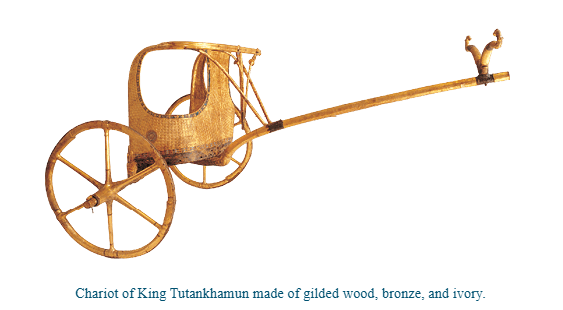
The Israelites are now on their way to the promised land and are being led by God personally, using a pillar of cloud during the day and a pillar of light at night. However pharaoh’s heart becomes hardened again when he realizes that he’s lost his entire workforce and decides to strike out after the Israelites with his army. The engagement comes to a head at the Red Sea where God performs a miracle through Moses of parting the Red Sea so effectively that the Israelites walk through on dry land and the entire army including pharaoh are drowned by the flooding back of the waters that had been piled on either side.
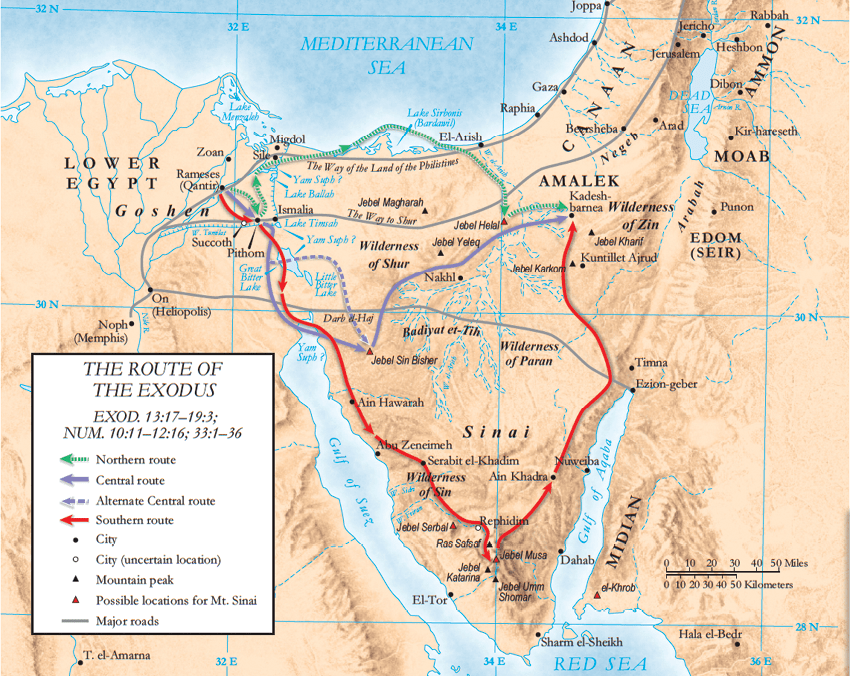
After the triumph of the Red Sea crossing the Israelites are now faced with the task finding food and drink for a nation of people who are wandering in the desert. After about 3 months of wandering the Israelites arrive at Mount Sinai here they camp, Moses receives his first vision of God, and the Israelites prepare to receive the terms of their covenant with Yahweh. The Israelites have become quite agitated after leaving their home (such as it was) for the uncertainty of the desert and now they wonder what are they going to hear from God
The Heart of God’s Covenant with Israel – Exodus 20-24
The Ten Commandments can be divided into two broad categories. Each of the first four statements governs Israel’s relationship to God, while the last six focus on societal issues. Both emphases are vital to the new nation’s survival. The basis of the covenant also has two parts: the identity of the Lord and God’s past action on Israel’s behalf (20:2). Because Yahweh is the God of Abraham, Isaac, and Jacob, he has ended their slavery. Therefore, God’s faithfulness and love are foundational to the standards the covenant professes. His relationship with them leads to the standards; the standards do not create the relationship. [Paul R. House; Eric Mitchell (2023). (p. 79). Old Testament Survey. B&H Publishing Group. Retrieved from https://read.lifeway.com]
Following the summary commands more detailed prescriptions are appear in the remainder of Exodus 20 through 23 and all of the moral force for these laws comes from the 10 Commandments and flow out from the respect for God and for the respect of their fellow Israelites. In this section are topics as broad as prohibiting idols, what to do with stolen or abused property, social concerns, and a few religious observations like Sabbath rest. At the end of chapter 24 the Israelites must decide whether they will accept this covenant or go on their own. Exo 24:3 So Moses came and told the people all the words of the LORD and all the judgments. And all the people answered with one voice and said, “All the words which the LORD has said we will do.” At this point Moses goes to the top of Mount Sinai to meet with the Lord for 40 days.
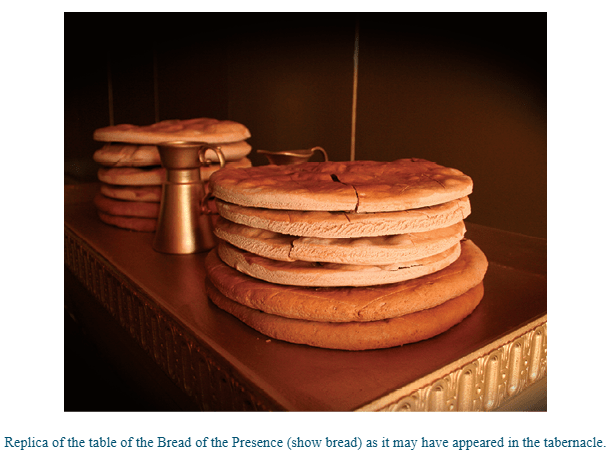
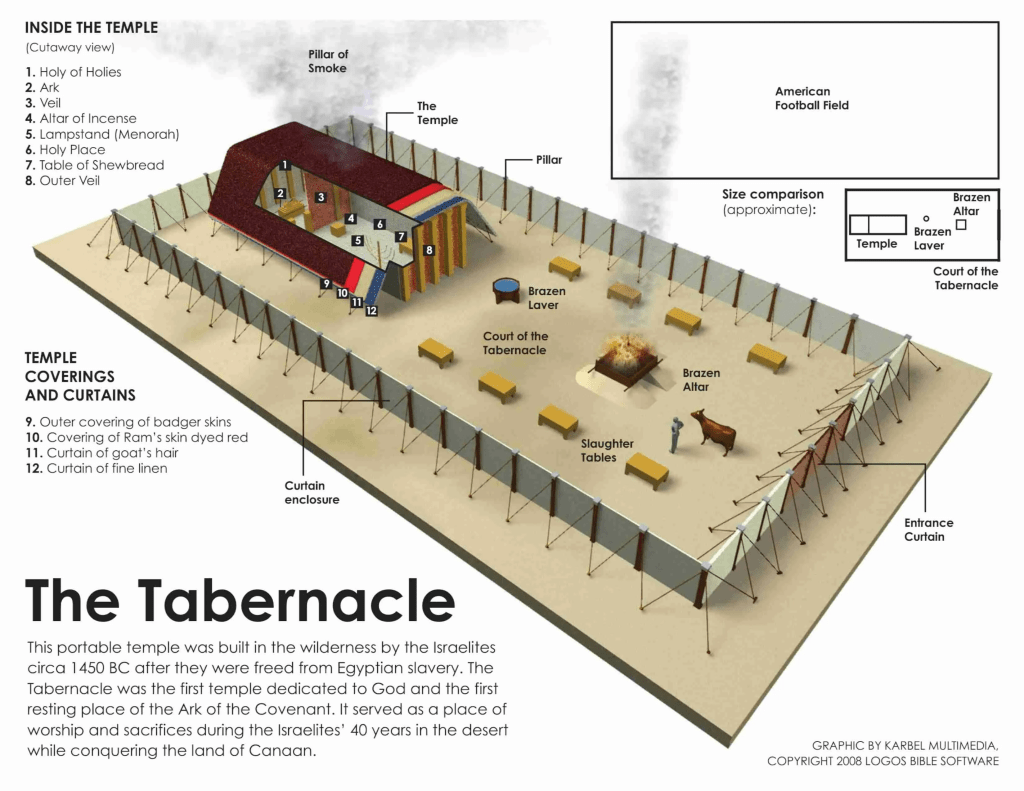
Now that Israel has accepted the terms of the covenant God gives them instructions on how to build a portable sanctuary known as a Tabernacle to take with them wherever they go it’s quite simple in its design it has a place for the ark of the covenant which will hold the stone tablets that contain the 10 commandments. It also holds a table, lamp stand, and ceremonial altar including an incense altar and a basin for washing the priest’s hands and feet. The Tabernacle has three areas: the courtyard, the holy place, and the holy of holies. The courtyard is an open space between the curtains that separate the worship from the rest of camp, and a tent that holds the holy place and holy of holies, Sacrifices are offered in the courtyard and inside the holy place the lampstand, table, and incense altar are used for prayer. The holy of holies is a room within the holy place where the ark of the covenant is kept and represents God’s presence at the heart of their camp.
The Breaking of the Covenant and Subsequent Renewal Exodus 32-34
during the time that Moses is on Mount Sinai he leaves Aaron in charge of the people . Due to the length of Moses absence the people begin getting anxious and unruly and demand that Aaron build them something to worship. Aaron crafts a golden calf for them to worship and even tells them that this is the God that brought them out of Egypt. Moses eventually returns from the Mount Sinai with the 10 commandment tablets and comes upon the revelers dancing around the golden calf and in his anger throws the commandments to the ground. Yahweh is equally as angry and offers to kill all of the Israelites and start over with Moses. Moses intercedes on their behalf but the people still face punishment. Moses grinds the gold calf, burns, and grinds the golden calf into a powder and puts it in water and the Israelites are forced to drink it which makes many of them sick and or end up dying. Because of Moses intercession Yahweh again pledges to give Israel a homeland if they will reject idolatry, keep the laws that he’s given them, and celebrate the prescribed festivals. Since the covenant has been restored, Moses status is God’s representative is cemented as his leadership has saved the nation from the deserved consequences of its own sinfulness.
Israel Builds the Tabernacle Exodus 35-40
In the final portion of Exodus, the people bring the offerings of gold and fabrics and other materials needed to build the Tabernacle. They bring so much that eventually they have to stop them bringing because things because they have too much. Once the Tabernacle is completed. God once again returns to their presence and descends into the Tabernacle.
Where Do We See Christ?
Passover
Perhaps nowhere in the Old Testament is Christ more evident than in the Passover celebration where an innocent lamb is slain and his blood protects the lives of the Israelites. This is why John when he sees Jesus refers to Him as the Lamb of God.
(Joh 1:29) The next day John saw Jesus coming toward him, and said, “Behold! The Lamb of God who takes away the sin of the world!
The Tabernacle
In the Tabernacle will he see a foreshadowing of Jesus’ incarnation to be among us as God was among the Israelites.
(Joh 1:14) And the Word became flesh and dwelt among us, and we beheld His glory, the glory as of the only begotten of the Father, full of grace and truth.
Point of Application
How can we apply this to our lives today?
In Exodus we see the foundation for many of the laws that we live today including: do not murder, do not lie, and others. Because our law rests upon these truths we can use this to point others to the original Law Giver who gives us life.
Discussion Questions
- We see several times in Exodus that the people of Israel grew anxious when they couldn’t see Moses, or didn’t have a visible representation of God to worship. How do we often look to other substitutes for God when we think we can’t see his face or “feel” His presence?
- Moses was very hesitant to go to pharaoh and do as the Lord commanded. Have there been any times in your life where you knew God was telling you to do something and you argued with him about it and/or didn’t do it?
Closing Prayer
Current Prayer Requests:
Richard Brooks – faith and courage during the next stage of his journey in Christ
Andrew McKinney – employment provision
Bob & Gaynelle – mother’s hospitalization (from Mike Arras)
Julia (Arras) – health
Doc – renewed vigor to join us on Saturdays
Lord, may your Word be a lamp unto our feet and a light unto our paths. Lift us up when we stumble. Assure us when we doubt. Lead us forth in confidence to share the reason for the Hope that lies within each of our hearts using the unique gifts and opportunities afforded to us all.
Additional Content
- The Bible Project’s guide to the Book of Exodus. Very good content.
Book of Exodus | Guide with Key Information and Resources
- Teaching from Chuck Swindoll on the Book of Exodus
- GotQuestions.org summary of the Book of Exodus
Summary of the Book of Exodus – Bible Survey | GotQuestions.org
 ☕Kindred Faith
Leave a comment