Memory Verse(s)
(Joshua 24:15) And if it seems evil to you to serve the LORD, choose for yourselves this day whom you will serve, whether the gods which your fathers served that were on the other side of the River, or the gods of the Amorites, in whose land you dwell. But as for me and my house, we will serve the LORD.”
Overview|Background
This book covers from the death of Moses to the death of Joshua.
Key Passage(s)
Joshua is commissioned
(1) After the death of Moses the servant of the LORD, it came to pass that the LORD spoke to Joshua the son of Nun, Moses’ assistant, saying:
(2) “Moses My servant is dead. Now therefore, arise, go over this Jordan, you and all this people, to the land which I am giving to them—the children of Israel.
(3) Every place that the sole of your foot will tread upon I have given you, as I said to Moses.
(4) From the wilderness and this Lebanon as far as the great river, the River Euphrates, all the land of the Hittites, and to the Great Sea toward the going down of the sun, shall be your territory.
(5) No man shall be able to stand before you all the days of your life; as I was with Moses, so I will be with you. I will not leave you nor forsake you.
(6) Be strong and of good courage, for to this people you shall divide as an inheritance the land which I swore to their fathers to give them.
(7) Only be strong and very courageous, that you may observe to do according to all the law which Moses My servant commanded you; do not turn from it to the right hand or to the left, that you may prosper wherever you go.
(8) This Book of the Law shall not depart from your mouth, but you shall meditate in it day and night, that you may observe to do according to all that is written in it. For then you will make your way prosperous, and then you will have good success.
(9) Have I not commanded you? Be strong and of good courage; do not be afraid, nor be dismayed, for the LORD your God is with you wherever you go.”
The Israelites Choose
Joshua 24:14-28
(14) “Now therefore, fear the LORD, serve Him in sincerity and in truth, and put away the gods which your fathers served on the other side of the River and in Egypt. Serve the LORD!
(15) And if it seems evil to you to serve the LORD, choose for yourselves this day whom you will serve, whether the gods which your fathers served that were on the other side of the River, or the gods of the Amorites, in whose land you dwell. But as for me and my house, we will serve the LORD.”
(16) So the people answered and said: “Far be it from us that we should forsake the LORD to serve other gods;
(17) for the LORD our God is He who brought us and our fathers up out of the land of Egypt, from the house of bondage, who did those great signs in our sight, and preserved us in all the way that we went and among all the people through whom we passed.
(18) And the LORD drove out from before us all the people, including the Amorites who dwelt in the land. We also will serve the LORD, for He is our God.”
(19) But Joshua said to the people, “You cannot serve the LORD, for He is a holy God. He is a jealous God; He will not forgive your transgressions nor your sins.
(20) If you forsake the LORD and serve foreign gods, then He will turn and do you harm and consume you, after He has done you good.”
(21) And the people said to Joshua, “No, but we will serve the LORD!”
(22) So Joshua said to the people, “You are witnesses against yourselves that you have chosen the LORD for yourselves, to serve Him.” And they said, “We are witnesses!”
(23) “Now therefore,” he said, “put away the foreign gods which are among you, and incline your heart to the LORD God of Israel.”
(24) And the people said to Joshua, “The LORD our God we will serve, and His voice we will obey!”
(25) So Joshua made a covenant with the people that day, and made for them a statute and an ordinance in Shechem.
(26) Then Joshua wrote these words in the Book of the Law of God. And he took a large stone, and set it up there under the oak that was by the sanctuary of the LORD.
(27) And Joshua said to all the people, “Behold, this stone shall be a witness to us, for it has heard all the words of the LORD which He spoke to us. It shall therefore be a witness to you, lest you deny your God.”
(28) So Joshua let the people depart, each to his own inheritance.
Key Facts
Authorship & Time Period
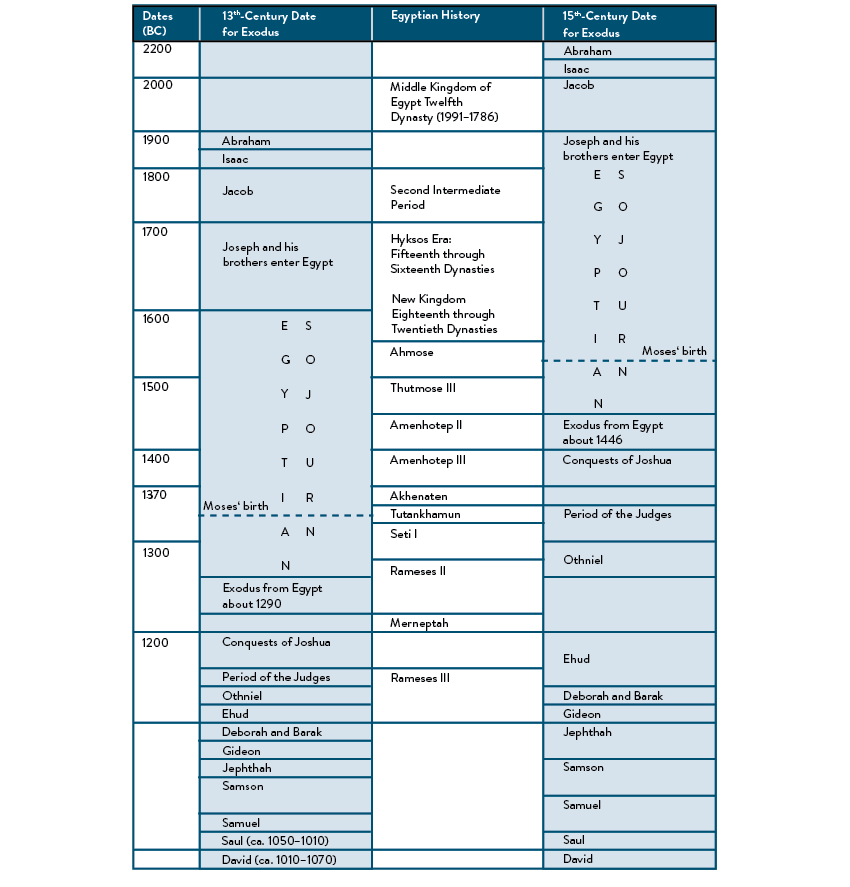
The completion of the book likely occurred around 1370 BC.
The book’s primary figure gives it its title. Joshua means “Yahweh saves,”1 an appropriate name for the man who led Israel, under God’s command, to victorious conquest of the Promised Land. Scholars believe that Joshua himself or a scribe under his direction penned most of the book. Early chapters include firsthand experiences (the NIV uses the pronouns “we” and “us” in Joshua 5:1,6, for example) and military details worthy of being known and recorded by a general. Joshua 24:26 refers to Joshua writing a portion of the book himself. After Joshua’s death, the high priests Eleazar or Phinehas may have supplemented some material in this book that alludes to events after the conquest (15:13–19; 19:47; 24:29–33).2
Type of literature
Historical narrative, legal
Characters
God, Joshua, Rahab, Achan, Caleb, Eleazar, and Phinehas
Key Events
The conquest of Jericho, Ai, Gibeon, and strategic northern and southern cities; the division of the land; and the covenant renewal ceremony at Shechem.
The Story
Summary
Joshua leads Israel’s conquest of Canaan. Israel divides the land and chooses to live as a covenant community. [Paul R. House; Eric Mitchell (2023). (p. 121). Old Testament Survey. B&H Publishing Group. Retrieved from https://read.lifeway.com]
Themes
- God keeps his promise to give Israel land
- Gentiles are included in God’s people
- God judges sin in all lands, and covenant faithfulness and renewal are part of Israel’s relationship with God.
Joshua Leads Israel – Joshua 1-5
- Reiteration to obey the commands of the Torah – Joshua 1
- The sending of the spies (Rahab’s assistance) – Joshua 2
- Crossing the Jordan into the Promised Land – Joshua 3-4
- Meeting the Angel of the Lord “Commander of the Lord’s Army” – Joshua 5
Battles with the Canaanites – Joshua 6-12
- Jericho – God’s faithfulness – Joshua 6
- Ai – Joshua 7-8
- Defeated
- Achan discovered
- Victorious
- The Gibeonites – conversion, worship of Yahweh – Joshua 9
- The Canaanite Kings – Joshua 11
- Recap of Israel’s Victories – Listing of the Kings defeated by Moses and Joshua – Joshua 12
Joshua Divides Up the Land – Joshua 13-22
- Very dry stuff, but important to the Israelites
Renewing the Covenant – Joshua’s Final Words – Joshua 23-24
- Similar to Moses parting words to Israel, Joshua highlights the blessings of faithfulness and the judgment of unfaithfulness
- He also leaves them with a choice
Where Do We See Christ?
Rahab of Jericho – in the lineage of Jesus
- Rahab is listed as one of the notable ancestors in the “Hall of Faith” (Hebrews 11) and she is commended for her works in the book of James
- (James 2:25) Likewise, was not Rahab the harlot also justified by works when she received the messengers and sent them out another way?
- (Hebrews 11:31) By faith the harlot Rahab did not perish with those who did not believe, when she had received the spies with peace.
- Rahab was saved by her faith and was part of the line and lineage of Christ, who was of the line of David.
- (Matthew 1:5-6a) Salmon begot Boaz by Rahab, Boaz begot Obed by Ruth, Obed begot Jesse,and Jesse begot David the king.
Point of Application
How can we apply this to our lives today?
The book is clear that when it comes to God’s holiness, He does not play favorites with nations. It can be tempting to believe that God somehow favors our country because of its Christian foundations. However, we belong to a better country Whose Architect is God.
Discussion Questions
- Modern people who first read Joshua can find it off-putting in its apparent genocidal focus. How do you feel about God seemingly telling the Israelites to wipe out nations or Him even destroying cities Himself as in the example of Jericho?
Closing Prayer
Go with us into this week, Holy Spirit. May our words be seasoned with the salt of faith. May we remember our works as acts of worship to You.
Current Prayer Requests:
Doc – renewed vigor to join us on Saturdays
Richard Brooks – faith and courage during the next stage of his journey in Christ
Andrew McKinney – employment provision
Bob & Gaynelle – mother’s hospitalization (from Mike Arras)
Julia (Arras) – health
Jim Sax – job situation, improvement, wisdom for interaction with leadership
Jim Allen, friend of Daryl, heart issue, VLAP operation
Daryl’s employee Tara – ill (possible tumor) in Cambodia
Tom and Jeanice – Divine Healing and Peace in their spirit
Becky and Lee Davidson, health and healing
Additional Content
Timeline of the Old Testament as conceptualized in the 13th and 15th centuries
FOR GREATER HISTORICAL UNDERSTANDING: PEOPLE GROUPS IN CANAAN
God mentions several people groups that the Israelites will displace in Canaan (Gen 15:19–21; Exod 3:8, 17; 23:23, 28; Deut 7:1–5). The word Canaanites is a general term that refers to Amorites, Hurrians (possibly the biblical Horites), Hittites, Philistines, Perizzites, Jebusites (in the central hill country), and Hivites (in Shechem and Gibeon).1
The Amorites lived and ruled in cities from northern Syria to the Mediterranean from 2000 to 1600 BC. It is possible that the Hyksos, who took over Egypt in this period, were Amorites. From the 1500s to the 1300s BC, the Hurrian kingdom of Mitanni in northern Syria dominated the region. Thus, many of the cities of Canaan began to be ruled by Hurrian factions. The Hittites were from the region of present-day Turkey. They controlled northern Lebanon after the demise of the Mitanni kingdom.2
The Philistines that Genesis mentions (10:14; 21:32; 26:1) were early settlers along the coast. These may not be the same Philistines that appear later in 1–2 Samuel and 1–2 Kings, who were southern European migrants. The Philistines, or “Sea Peoples,” migrated to Canaan in stages. The Hivites were descendants of Noah through Ham and Canaan. Jacob made a covenant with the people of Shechem, and later Joshua made a peace treaty with the people of Gibeon, both of whom were Hivites. The Perizzites were possibly a Semitic people living in the western section of the Jordan Valley. The Jebusites were non-Semitic descendants of Ham and Canaan who lived in the central hill country and in Jerusalem. These nations were to be entirely dispossessed.3 [Paul R. House; Eric Mitchell (2023). (p. 118). Old Testament Survey. B&H Publishing Group. Retrieved from https://read.lifeway.com%5D

Leave a comment