Memory Verse(s)
(Judges 21:25) In those days there was no king in Israel; everyone did what was right in his own eyes.
Overview|Background
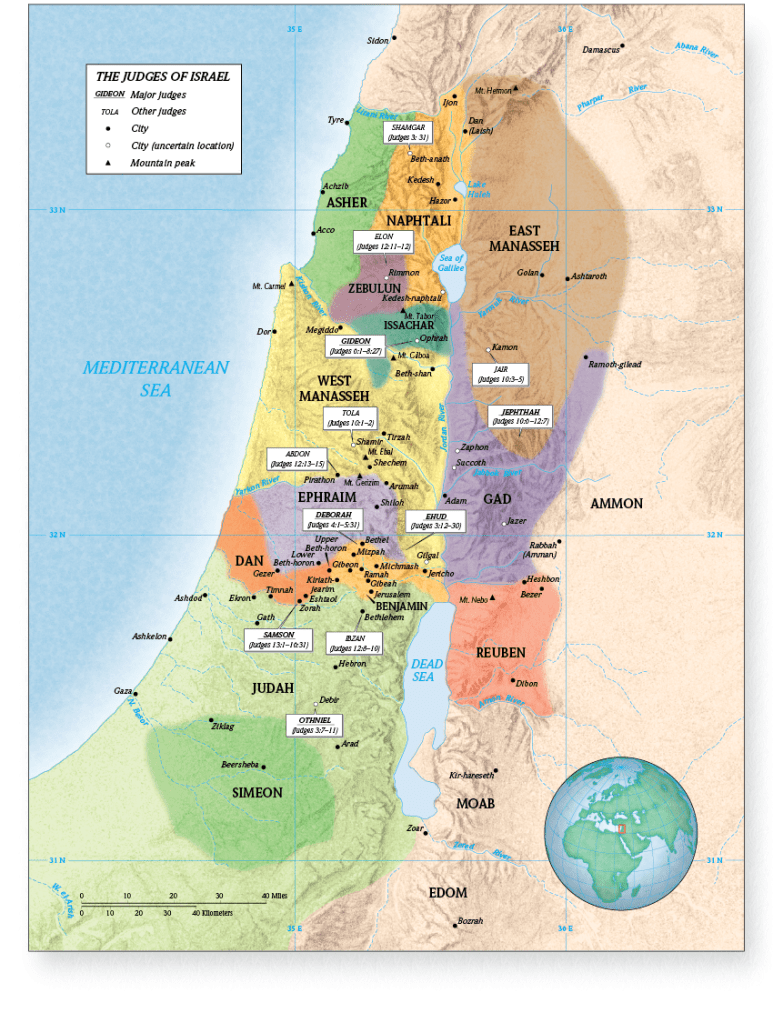
The Book of Judges covers about 330 years of Israel’s history (c. 1383 BC to c. 1052 BC) and is a tragic account of how Yahweh [God] was taken for granted by His children year after year, century after century. Judges is a sad contrast to the book of Joshua which chronicles the blessings God bestowed on the Israelites for their obedience in conquering the land. In Judges, they were disobedient and idolatrous, leading to their many defeats. Yet God has never failed to open His arms in love to His people whenever they repent from their wicked ways and call upon His name (Judges 2:18). Through the twelve judges of Israel, God honored His promise to Abraham to protect and bless his offspring (Genesis 12:2-3).
After the death of Joshua and his contemporaries, the Israelites returned to serving Baal and Ashtaroth. God allowed the Israelites to suffer the consequences of worshiping false gods. It was then that the people of God would cry out to Yahweh for help. God sent His children judges to lead them in righteous living. But time after time they would turn their backs on God and return to their lives of wickedness. However, keeping His part of the covenant with Abraham, God would save His people from their oppressors throughout the 480-year span of the Book of Judges.
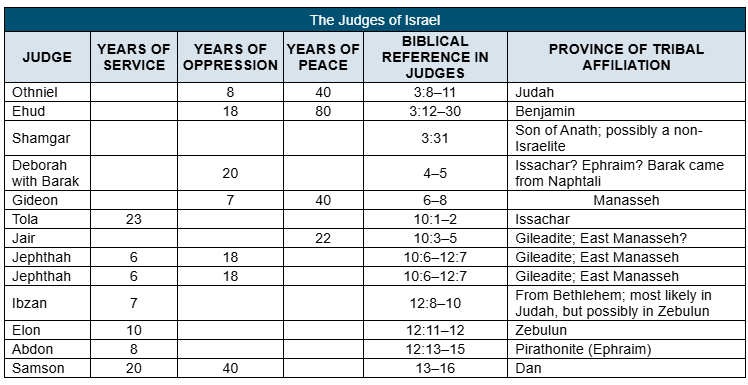
Probably the most notable judge was the 12th judge, Samson, who came to lead the Israelites after a 40-year captivity under the rule of the ruthless Philistines. Samson led God’s people to victory over the Philistines where he lost his own life after 20 years as judge of Israel.
Key Passage(s)
Judges 2:1-23
(1) Then the Angel of the LORD came up from Gilgal to Bochim, and said: “I led you up from Egypt and brought you to the land of which I swore to your fathers; and I said, ‘I will never break My covenant with you.
(2) And you shall make no covenant with the inhabitants of this land; you shall tear down their altars.’ But you have not obeyed My voice. Why have you done this?
(3) Therefore I also said, ‘I will not drive them out before you; but they shall be thorns in your side, and their gods shall be a snare to you.’ “
(4) So it was, when the Angel of the LORD spoke these words to all the children of Israel, that the people lifted up their voices and wept.
(5) Then they called the name of that place Bochim; and they sacrificed there to the LORD.
(6) And when Joshua had dismissed the people, the children of Israel went each to his own inheritance to possess the land.
(7) So the people served the LORD all the days of Joshua, and all the days of the elders who outlived Joshua, who had seen all the great works of the LORD which He had done for Israel.
(8) Now Joshua the son of Nun, the servant of the LORD, died when he was one hundred and ten years old.
(9) And they buried him within the border of his inheritance at Timnath Heres, in the mountains of Ephraim, on the north side of Mount Gaash.
(10) When all that generation had been gathered to their fathers, another generation arose after them who did not know the LORD nor the work which He had done for Israel.
(11) Then the children of Israel did evil in the sight of the LORD, and served the Baals;
(12) and they forsook the LORD God of their fathers, who had brought them out of the land of Egypt; and they followed other gods from among the gods of the people who were all around them, and they bowed down to them; and they provoked the LORD to anger.
(13) They forsook the LORD and served Baal and the Ashtoreths.
(14) And the anger of the LORD was hot against Israel. So He delivered them into the hands of plunderers who despoiled them; and He sold them into the hands of their enemies all around, so that they could no longer stand before their enemies.
(15) Wherever they went out, the hand of the LORD was against them for calamity, as the LORD had said, and as the LORD had sworn to them. And they were greatly distressed.
(16) Nevertheless, the LORD raised up judges who delivered them out of the hand of those who plundered them.
(17) Yet they would not listen to their judges, but they played the harlot with other gods, and bowed down to them. They turned quickly from the way in which their fathers walked, in obeying the commandments of the LORD; they did not do so.
(18) And when the LORD raised up judges for them, the LORD was with the judge and delivered them out of the hand of their enemies all the days of the judge; for the LORD was moved to pity by their groaning because of those who oppressed them and harassed them.
(19) And it came to pass, when the judge was dead, that they reverted and behaved more corruptly than their fathers, by following other gods, to serve them and bow down to them. They did not cease from their own doings nor from their stubborn way.
(20) Then the anger of the LORD was hot against Israel; and He said, “Because this nation has transgressed My covenant which I commanded their fathers, and has not heeded My voice,
(21) I also will no longer drive out before them any of the nations which Joshua left when he died,
(22) so that through them I may test Israel, whether they will keep the ways of the LORD, to walk in them as their fathers kept them, or not.”
(23) Therefore the LORD left those nations, without driving them out immediately; nor did He deliver them into the hand of Joshua.
Key Facts
Authorship & Time Period
The Book of Judges was likely written between 1045 and 1000 B.C.
The Book of Judges does not specifically name its author. The tradition is that the Prophet Samuel was the author of Judges. Internal evidence indicates that the author of Judges lived shortly after the period of the Judges. Samuel fits this qualification.
Summary of the Book of Judges – Bible Survey | GotQuestions.org
Type of literature
Historical narrative, hero tales
Characters
God, Othniel, Ehud, Deborah, Barak, Gideon, Abimelech, Jephthah, Samson, Micah, an unnamed Levite
Key Events
Joshua’s death, Deborah and Barak’s victory, Gideon’s defeat of the Midianites, Jephthah’s victory over Ammon, Samson’s battles with the Philistines, the rape and murder of a Levite’s concubine, and the decimation of the tribe of Benjamin in a civil war.
The Story
Summary
Chaos reigns because Israel disobeys the covenant. God sends other nations to oppress Israel so they will repent. When Israel turns back to God, he rescues them from their enemies by sending civil and military leaders called “judges.” Israel falls back repeatedly into their sinful habits, often with dire consequences.
Themes
- Israel’s decline into sinful actions
- God correcting his people through historical circumstances
- God responding to repentance and delivering his people
- The danger of people living by their own standards rather than God’s
The Roots of Chaos – Judges 1:1–2:5
- Struggling to complete the conquest, Judah leads the way – Judges 1:1-2
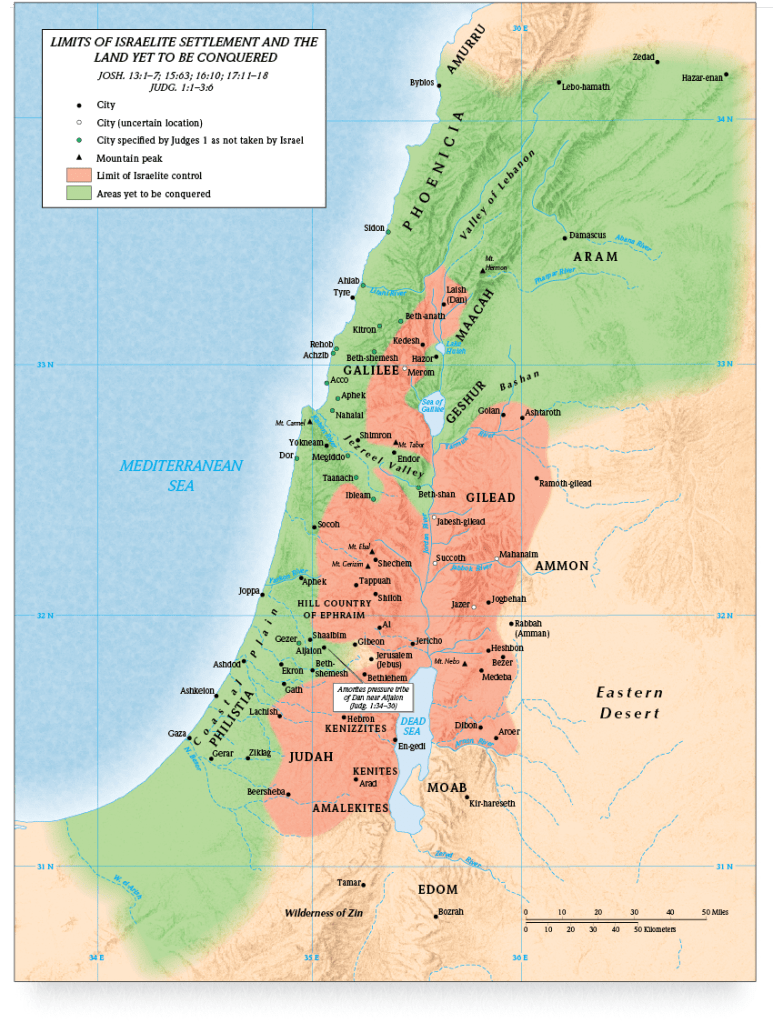
- Several other tribes capture their land – Judges 1:3-36
- Israel does not displace the Canaanites – Judges 1:28-29, 33, 35
- The remaining Canaanites become a thorn to Israel – Judges 2:1-3
- The Lord uses their enemies as a judgement and Israel knows they deserve it – Judges 2:4-5
Choosing to Live in Chaos – Judges 2:6–16:31
- Israel plunges into a sin cycle of worshipping other gods, defeat by other nations, calling out to God to send help, the judges come, the people fall back into idolatry
The Consequences of Living in Chaos – Judges 17–21
- There is no judge, no king and everyone does what is right in his own eyes. These are some of the most horrible stories of violence in the Bible.
Where Do We See Christ?
Samson’s Mother
The announcement to Samson’s mother that she would bear a son to lead Israel is a foreshadowing of the announcement to Mary of the birth of the Messiah. God sent His Angel to both women and told them they would “conceive and bear a son” (Judges 13:7; Luke 1:31) who would lead God’s people.
Point of Application
How can we apply this to our lives today?
Disobedience always brings judgement. We are reminded of this in Hebrews 12
Hebrews 12:5-11
(5) And you have forgotten the exhortation which speaks to you as to sons: “MY SON, DO NOT DESPISE THE CHASTENING OF THE LORD, NOR BE DISCOURAGED WHEN YOU ARE REBUKED BY HIM;
(6) FOR WHOM THE LORD LOVES HE CHASTENS, AND SCOURGES EVERY SON WHOM HE RECEIVES.”
(7) If you endure chastening, God deals with you as with sons; for what son is there whom a father does not chasten?
(8) But if you are without chastening, of which all have become partakers, then you are illegitimate and not sons.
(9) Furthermore, we have had human fathers who corrected us, and we paid them respect. Shall we not much more readily be in subjection to the Father of spirits and live?
(10) For they indeed for a few days chastened us as seemed best to them, but He for our profit, that we may be partakers of His holiness.
(11) Now no chastening seems to be joyful for the present, but painful; nevertheless, afterward it yields the peaceable fruit of righteousness to those who have been trained by it.
Discussion Questions
- How can we lovingly warn a fellow believer about behavior that will lead to chastisement if it continues?
Closing Prayer
Go with us into this week, Holy Spirit. May our words be seasoned with the salt of faith. May we remember our works as acts of worship to You.
Current Prayer Requests:
Doc – renewed vigor to join us on Saturdays
Richard Brooks – faith and courage during the next stage of his journey in Christ
Andrew McKinney – employment provision
Bob & Gaynelle – mother’s hospitalization (from Mike Arras)
Julia (Arras) – health
Jim Sax – job situation, improvement, wisdom for interaction with leadership
Jim Allen, friend of Daryl, heart issue, VLAP operation
Daryl’s employee Tara – ill (possible tumor) in Cambodia
Tom and Jeanice – Divine Healing and Peace in their spirit
Becky and Lee Davidson, health and healing
Jim & Melissa, father-in-law’s heart condition and spiritual health, marital closeness
Mike Arras’ daughter, mental and spiritual health
Additional Content
FOR GREATER HISTORICAL UNDERSTANDING: THE DATE OF THE JUDGES’ ERA
As was discussed previously, there are two viable dates for the exodus (c. 1446 and 1290 BC). The second date leaves less time for the events in Joshua, Judges, and 1 Samuel 1–8 to unfold. The Stele of Merneptah indicates that Israel was in Canaan by 1207 BC (see p. 140).4
The Amarna letters (1373–1353 BC; see p. 139) may support the early date. They were written by kings of cities to Egypt’s pharaoh. These letters include requests for help against the “Apiru,” who were harassing them. The word Apiru means “those who are out from under authority, or outlaws.” Some of the Apiru mentioned in the Amarna letters may have been Israelites (see p. 10).5 Egypt did not send help. Israel could have succeeded in their invasion under such circumstances.
The book of Joshua indicates that Israel took a long time to follow up on early victories. For instance, the text states that Israel captured several cities, but it only mentions burning Ai, Jericho, and Hazor (Josh 6:24; 8:28; and 11:13). There is evidence of a Late Bronze Age (1550–1200 BC) destruction at Hazor. Judges 4:2, 17, and 24 describe Israel fighting against Hazor’s king later.
Judges 1–2 states clearly that the Israelites did not drive out all the nations of Canaan. Thus, if the Israelites burned Hazor in Joshua’s time and did not occupy the city, then the Canaanites may have inhabited the place again and refortified it. As time passed, the Israelites settled in the land and coexisted with the Canaanites. As the Israelites turned from God, the Canaanites, Midianites, Moabites, and Philistines gained strength and oppressed them. Over time Israelites moved into the central hill country for safety from invaders.
Another argument for the early date is Jephthah’s statement in Judg 11:26 that Israel had lived in the Transjordan for three hundred years. While the chronology of Judges is difficult to reconstruct, even if Jephthah’s judgeship was late in that period (for instance 1075 BC), three hundred years would place the conquest at the early date.
Much has been written about how controlling iron metallurgy allowed the Philistines to subjugate Israel. However, wrought iron was costly and was at first used for jewelry. Wrought iron is softer than bronze. Bronze made for better weapons than iron until iron began to be carbonized (made into steel by heating iron in coal). Bronze tools can be given a new sharp edge by using a hammer, but iron and steel require a whetstone and the specialized work of a blacksmith. The transition from wrought iron to steel happened gradually and did not happen consistently until the time of the Hebrew monarchy about 1000–700 BC. This is affirmed by 1 Sam 13:19–22, which states that the Philistines regulated the blacksmith profession. This was in accord with Israel’s subservience to the Philistines.6 [Paul R. House; Eric Mitchell (2023). (p. 140). Old Testament Survey. B&H Publishing Group. Retrieved from https://read.lifeway.com%5D

Leave a comment