Memory Verse(s)
(2 Samuel 22:2-4)
(2) And he said: “The LORD is my rock and my fortress and my deliverer;
(3) The God of my strength, in whom I will trust; My shield and the horn of my salvation, My stronghold and my refuge; My Savior, You save me from violence.
(4) I will call upon the LORD, who is worthy to be praised; So shall I be saved from my enemies.
Overview|Background
1 and 2 Samuel are named after the person God used to establish monarchy in Israel. Samuel not only anointed both Saul and David, Israel’s first two kings, but he also gave definition to the new order of God’s rule over Israel. Samuel’s role as God’s representative in this period of Israel’s history is close to that of Moses (see Ps 99:6; Jer 15:1) since he, more than any other person, provided for covenant continuity in the transition from the rule of the judges to that of the monarchy.
1 and 2 Samuel were originally one book. It was divided into two parts by the translators of the Septuagint (the pre-Christian Greek translation of the OT) — a division subsequently followed by Jerome (in the Latin Vulgate, c. a.d. 400) and by modern versions. The title of the book has varied from time to time, having been designated “The First and Second Books of Kingdoms” (Septuagint), “First and Second Kings” (Vulgate) and “First and Second Samuel” (Hebrew tradition and most modern versions).
Key Passage(s)
Hannah’s Prayer – 1 Samuel 2:1-10
(1) And Hannah prayed and said: “My heart rejoices in the LORD; My horn is exalted in the LORD. I smile at my enemies, Because I rejoice in Your salvation.
(2) “No one is holy like the LORD, For there is none besides You, Nor is there any rock like our God.
(3) “Talk no more so very proudly; Let no arrogance come from your mouth, For the LORD is the God of knowledge; And by Him actions are weighed.
(4) “The bows of the mighty men are broken, And those who stumbled are girded with strength.
(5) Those who were full have hired themselves out for bread, And the hungry have ceased to hunger. Even the barren has borne seven, And she who has many children has become feeble.
(6) “The LORD kills and makes alive; He brings down to the grave and brings up.
(7) The LORD makes poor and makes rich; He brings low and lifts up.
(8) He raises the poor from the dust And lifts the beggar from the ash heap, To set them among princes And make them inherit the throne of glory. “For the pillars of the earth are the LORD’s, And He has set the world upon them.
(9) He will guard the feet of His saints, But the wicked shall be silent in darkness. “For by strength no man shall prevail.
(10) The adversaries of the LORD shall be broken in pieces; From heaven He will thunder against them. The LORD will judge the ends of the earth. “He will give strength to His king, And exalt the horn of His anointed.”
The rejection of Samuel – 1 Samuel 15:22-23
(22) So Samuel said: “Has the LORD as great delight in burnt offerings and sacrifices, As in obeying the voice of the LORD? Behold, to obey is better than sacrifice, And to heed than the fat of rams.
(23) For rebellion is as the sin of witchcraft, And stubbornness is as iniquity and idolatry. Because you have rejected the word of the LORD, He also has rejected you from being king.”
The annointing of David – 1 Samuel 16:1-13
(1) Now the LORD said to Samuel, “How long will you mourn for Saul, seeing I have rejected him from reigning over Israel? Fill your horn with oil, and go; I am sending you to Jesse the Bethlehemite. For I have provided Myself a king among his sons.”
(2) And Samuel said, “How can I go? If Saul hears it, he will kill me.” But the LORD said, “Take a heifer with you, and say, ‘I have come to sacrifice to the LORD.’
(3) Then invite Jesse to the sacrifice, and I will show you what you shall do; you shall anoint for Me the one I name to you.”
(4) So Samuel did what the LORD said, and went to Bethlehem. And the elders of the town trembled at his coming, and said, “Do you come peaceably?”
(5) And he said, “Peaceably; I have come to sacrifice to the LORD. Sanctify yourselves, and come with me to the sacrifice.” Then he consecrated Jesse and his sons, and invited them to the sacrifice.
(6) So it was, when they came, that he looked at Eliab and said, “Surely the LORD’s anointed is before Him!”
(7) But the LORD said to Samuel, “Do not look at his appearance or at his physical stature, because I have refused him. For the LORD does not see as man sees; for man looks at the outward appearance, but the LORD looks at the heart.”
(8) So Jesse called Abinadab, and made him pass before Samuel. And he said, “Neither has the LORD chosen this one.”
(9) Then Jesse made Shammah pass by. And he said, “Neither has the LORD chosen this one.”
(10) Thus Jesse made seven of his sons pass before Samuel. And Samuel said to Jesse, “The LORD has not chosen these.”
(11) And Samuel said to Jesse, “Are all the young men here?” Then he said, “There remains yet the youngest, and there he is, keeping the sheep.” And Samuel said to Jesse, “Send and bring him. For we will not sit down till he comes here.”
(12) So he sent and brought him in. Now he was ruddy, with bright eyes, and good-looking. And the LORD said, “Arise, anoint him; for this is the one!”
(13) Then Samuel took the horn of oil and anointed him in the midst of his brothers; and the Spirit of the LORD came upon David from that day forward. So Samuel arose and went to Ramah.
Key Facts
Authorship & Time Period
Originally, the books of 1 and 2 Samuel were one book. The translators of the Septuagint separated them, and we have retained that separation ever since. The events of 1 Samuel span approximately 100 years, from c. 1100 B.C. to c. 1000 B.C. The events of 2 Samuel cover another 40 years. The date of writing, then, would be sometime after 960 B.C.
The author of 1 Samuel is anonymous. We know that Samuel wrote a book (1 Samuel 10:25), and it is very possible that he wrote part of this book as well. Other possible contributors to 1 Samuel are the prophets/historians Nathan and Gad (1 Chronicles 29:29). Full article: Who wrote the book of 1 Samuel? Who was the author of 1 Samuel?
The Book of 2 Samuel does not identify its author. It could not be the Prophet Samuel, since he died in 1 Samuel. Possible writers include Nathan and Gad (see 1 Chronicles 29:29). Full Article: Who wrote the book of 2 Samuel? Who was the author of 2 Samuel?
Type of literature
Historical narrative, poetry
Characters
MAJOR CHARACTERS: God, Samuel, Saul, Jonathan, David, and Absalom.
KEY MINOR CHARACTERS: Hannah, Eli, Abner, Joab, Nathan, Uriah, and Bathsheba
The Story
Summary
Jim Sachs – job situation, improvement, wisdom for interaction with leadership
Much of the chronological confusion that surrounds the events from the exodus through the judges disappears by the time 1–2 Samuel begins. Because of the comprehensive portrayal of Israel’s kings in 1–2 Samuel, 1–2 Kings, and Chronicles, as well as the existence of writings from other nations, most of the incidents in the rest of the Old Testament can be dated with much greater precision.
Samuel leads Israel for a minimum of twenty years (1 Sam 7:2); Saul probably rules for about forty years (1 Sam 13:1); then David becomes king near 1010 BC. These dates are approximate but adequate. Israel undergoes many changes in this era. Their government, religion, and societal structure are all altered by what happens.
Major Events
- Samuel’s ministry, Saul’s rise and fall
- David’s emergence
- God’s promise of an eternal kingdom to David
- David’s adultery with Bathsheba
- Absalom’s revolt
Themes
- God establishes kingship ruled by his standards
- God gives Israel rest in their land
- God promises that the Messiah will come through David’s family
- God chooses Jerusalem as the place for the temple.
Outline of 1 & 2 Samuel
- Historical Setting for the Beginning of Kingship in Israel (chs. 1–7)
- The Beginning of Kingship in Israel under the Guidance of Samuel (8:1;16:13)
- The Establishment of Kingship in Israel (16:14;31:13)
- The Rise of David (16:14;27:12)
- David enters Saul’s service (16:14;17:58)
- David becomes alienated from Saul (chs. 18–19)
- Jonathan protects David from Saul (ch. 20)
- David continues to elude Saul (21:1;22:5)
- Saul kills the priests at Nob (22:6-23)
- David rescues the people of Keilah (23:1-6)
- Saul continues to pursue David (23:7-29)
- David spares Saul’s life (ch. 24)
- David threatens Nabal’s life (ch. 25)
- David spares Saul’s life again (ch. 26)
- David enters Achish’s service (ch. 27)
- The End of Saul’s Reign (chs. 28–31)
- The Rise of David (16:14;27:12)
- The Consolidation of Kingship in Israel (2Sa 1-20)
- David’s Lament over Saul and Jonathan (ch. 1)
- David Becomes King over Judah (chs. 2–4)
- David Becomes King over All Israel (5:1-5)
- David Conquers Jerusalem (5:6-25)
- David Brings the Ark to Jerusalem (ch. 6)
- God Promises David an Everlasting Dynasty (ch. 7)
- The Extension of David’s Kingdom (ch. 8)
- David’s Faithfulness to His Covenant with Jonathan (ch. 9)
- David Commits Adultery and Murder (chs. 10–12)
- David Loses His Son Amnon (chs. 13–14)
- David Loses His Son Absalom (chs. 15–20)
- Final Reflections on David’s Reign (2Sa 21-24)
Where Do We See Christ?
The Messiah in the Bible
The Hebrew word translated as “Messiah” means “anointed one,” the one chosen to rule. The word “Christ” is the Greek term for “Messiah.” In the Old Testament, prophets (1 Kgs 19:16), priests (Exod 29:7), and kings (1 Sam 16:13) were anointed with oil at the start of their service. The oil represented God’s presence and power in their lives for the tasks they performed. By New Testament times, the term “Messiah” referred to the promised son of David, a king who would rule and save the people (John 1:41; 4:25).
The Old Testament presents the Messiah as the most important person in human history. He is the focal point of God’s plans to provide salvation from sin to those who believe. Passages in every section of the Old Testament speak of the Messiah explicitly or by implication.6
Christians believe that Jesus of Nazareth is this Messiah the Scriptures promise (Luke 24:27, 44). He is a descendant of Adam, yet without sin. He is fully God (Isa 9:6–7; John 1:1–14), thus able to redeem people from their sins. He is a son of Abraham, an Israelite. He is from the tribe of Judah and the family of David. He meets all the criteria for Israelite kingship (Deut 17:14–20). He is a willing redeemer who died to pay the penalty for humanity’s sins (Isa 52:13–53:12; Luke 22:66–23:45). He taught the people to know God and initiated the new covenant through his blood (Jer 31:31–34; Luke 22:20). After his death, he rose from the dead and taught his disciples (Isa 53:10–12; Matt 28:1–20). He ascended into heaven (Acts 1:6–11; Dan 7:13–14). He will return one day in power to gather his people and end injustice (Joel 2:30–32; Rev 19:11–21).
Point of Application
How can we apply this to our lives today?
Saul made the mistake of thinking he could please God through disobedience. Like many today, he believed that a sensible motive will compensate for bad behavior. Perhaps his power went to his head, and he began to think he was above the rules. Somehow he developed a low opinion of God’s commands and a high opinion of himself. Even when confronted with his wrongdoing, he attempted to vindicate himself, and that’s when God rejected him (15:16-28).
Saul’s problem is one we all face—a problem of the heart. Obedience to God’s will is necessary for success, and if we in pride rebel against Him, we set ourselves up for loss.
Anyone can fall. Even a man like David, who truly desired to follow God and who was richly blessed by God, was susceptible to temptation. David’s sin with Bathsheba should be a warning to all of us to guard our hearts, our eyes, and our minds. Pride over our spiritual maturity and our ability to withstand temptation in our own strength is the first step to a downfall (1 Corinthians 10:12).
Discussion Questions
- What current beliefs do we see in the world that have a sensible or even noble motive but are in opposition to God’s direction for human thriving?
Closing Prayer
Lord, teach us to number our days and to devote each of them to knowing you better and seeking you fully. Let us lean not on our own understanding but on Yours.
Current Prayer Requests:
Doc – renewed vigor to join us on Saturdays
Richard Brooks – faith and courage during the next stage of his journey in Christ
Andrew McKinney – employment provision
Bob & Gaynelle – mother’s hospitalization (from Mike Arras)
Julia (Arras) – health
Jim Allen, friend of Daryl, heart issue, VLAP operation
Daryl’s employee Tara – ill (possible tumor) in Cambodia
Daryl’s Grandson, Mack and Mack’s parents Jonathan and Lizz. Healing for Mack, comfort for Jonathan and Lizz
Tom and Jeanice – Divine Healing and Peace in their spirit
Becky and Lee Davidson, health and healing
Jim & Melissa, father-in-law’s heart condition and spiritual health, marital closeness
Mike Arras’ daughter, mental and spiritual health
Mike Arras’ son, Trevor – employment
Mike Allen – sister Adele and brother
Additional Content
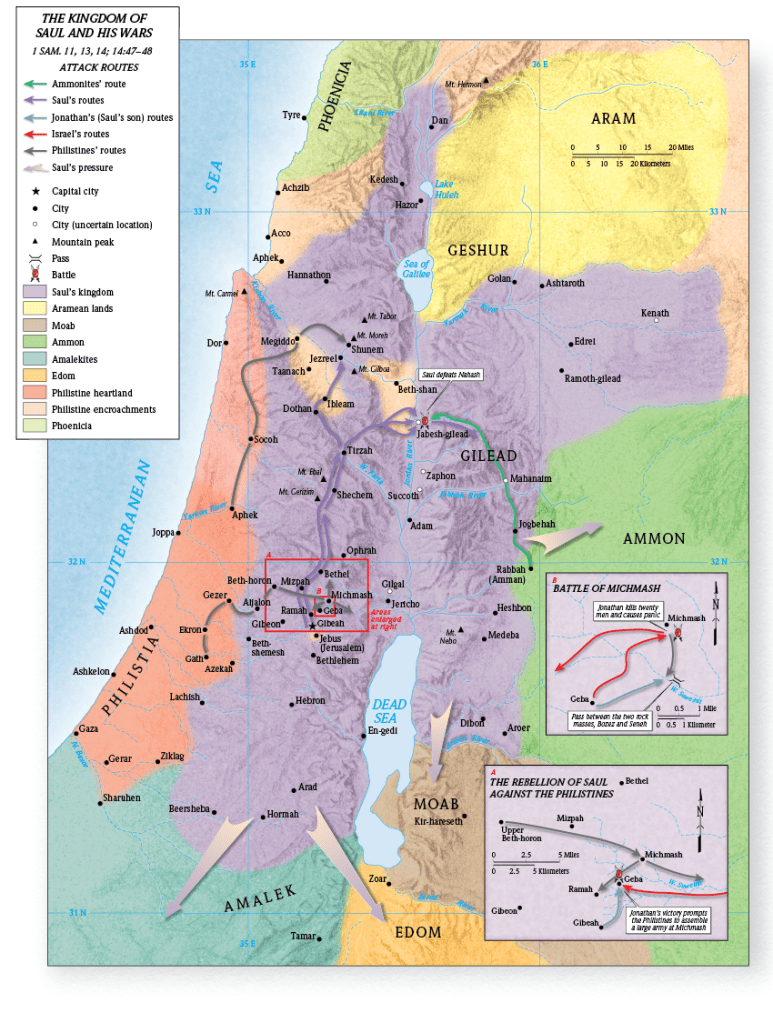
FOR GREATER HISTORICAL UNDERSTANDING: SAUL’S KINGDOM
At the time of Saul’s rise to kingship (c. 1050 BC), the Philistines remained the primary threat to the Israelites. Saul also fought against the Ammonites, Amalekites, Edomites, and kings of Zobah (1 Sam 14:47–48). Saul’s kingdom was not large (see the map on the following page). It consisted essentially of the central and northern hill country, Galilee, and parts of Transjordan. The remains of a structure considered to be Saul’s palace/fortress have been excavated by archaeologists in Gibeah, Saul’s hometown and later capital in the Benjamite territory. It is a small (52 m x 35 m) enclosure with a tower (13 m x 9 m). It dates to the eleventh century BC and is located a few miles north of Jerusalem at what is today Tel El-Ful.1
The Philistines held five cities in the southeastern coastal plain (Gaza, Ashdod, Ashkelon, Gath, and Ekron), as well as other cities such as Beth Shean. There were also Canaanite cities still sprinkled throughout the land (Jerusalem, Gibeon, Gezer, etc.). [Paul R. House; Eric Mitchell (2023). (p. 167). Old Testament Survey. B&H Publishing Group. Retrieved from https://read.lifeway.com%5D
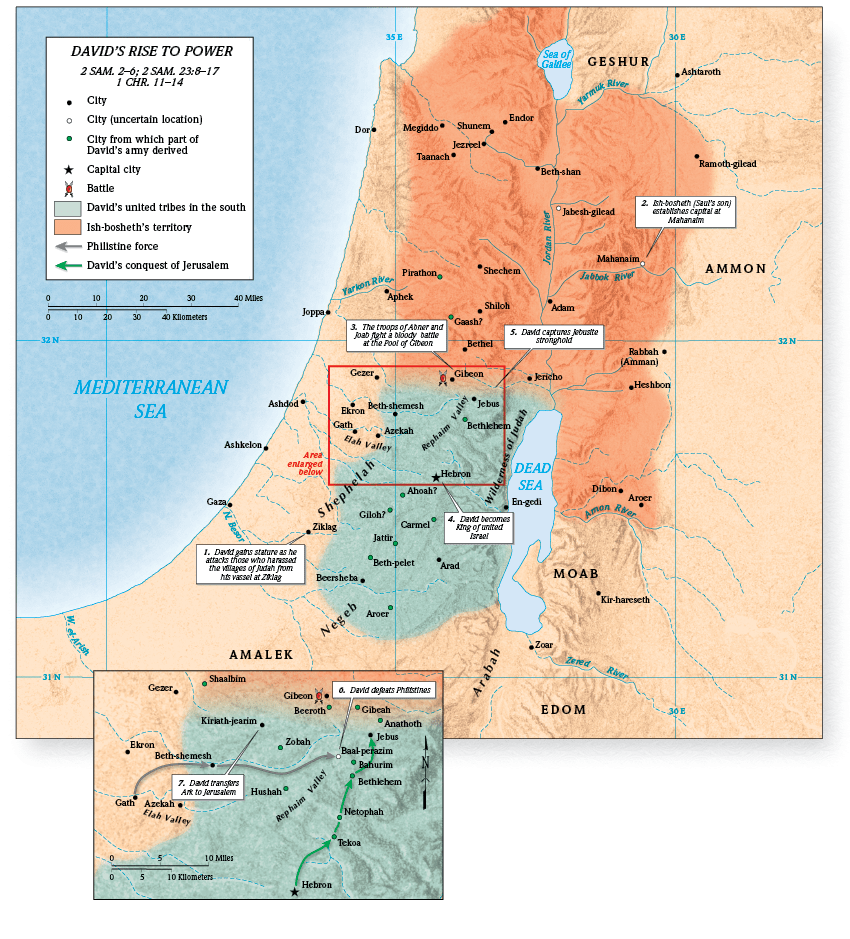
FOR GREATER HISTORICAL UNDERSTANDING: DAVID’S RISE TO POWER
Saul’s son Ish-bosheth ruled over the northern tribes for two years. David ruled over Judah seven years and then over all the tribes for thirty-three years. David (1010–970 BC) finally subjugated the Philistines and every other small state in the area (Edom, Moab, Ammon, and others). No foreign power would figure into the political picture of Canaan until after the time of Solomon. David made trade agreements with the Phoenicians, who ruled shipping on the Mediterranean Sea at this time. David did not conquer and annihilate his opponents, choosing instead to rule as sovereign over the local inhabitants and collect tribute monies. David’s personal bodyguards were Philistines (the Cherethites and Perethites), as well as one of the commanders of his army, Ittai, from Goliath’s hometown of Gath. [Paul R. House; Eric Mitchell (2023). (p. 181). Old Testament Survey. B&H Publishing Group. Retrieved from https://read.lifeway.com%5D

Leave a comment