Memory Verse(s)
And they sang responsively, praising and giving thanks to the LORD: “For He is good, For His mercy endures forever toward Israel.” Then all the people shouted with a great shout, when they praised the LORD, because the foundation of the house of the LORD was laid.
Overview|Background
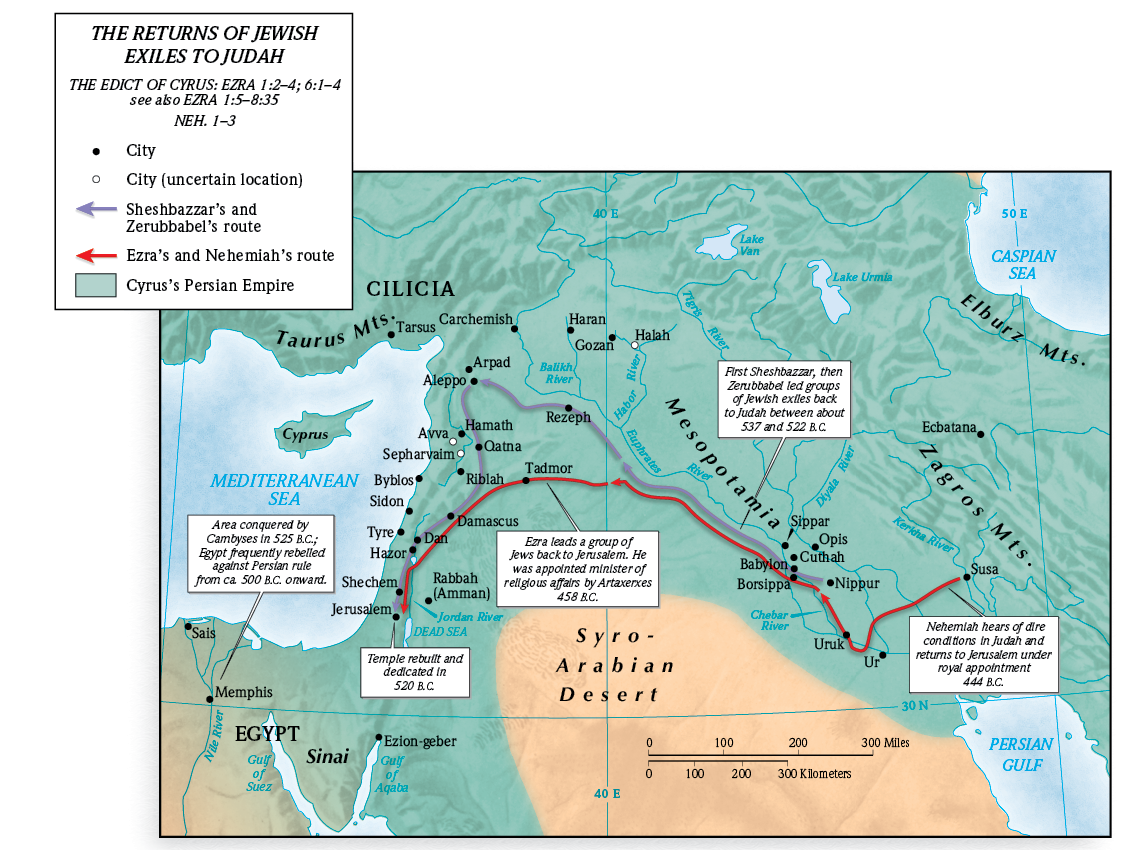
We will be studying both of these books together as it is likely they were one book and tell a continuing narrative of the rebuilding of Jerusalem and the Temple.
The book of Ezra may be divided as follows: Chapters 1-6—The First Return under Zerubbabel, and the Building of the Second Temple. Chapters 7-10—The Ministry of Ezra. Since well over half a century elapsed between chapters 6 and 7, the characters of the first part of the book had died by the time Ezra began his ministry in Jerusalem. Ezra is the one person who is prominent in the Books of Ezra and Nehemiah. Both books end with prayers of confession (Ezra 9; Nehemiah 9) and a subsequent separation of the people from the sinful practices into which they had fallen. Some concept of the nature of the encouraging messages of Haggai and Zechariah, who are introduced in this narrative (Ezra 5:1), may be seen in the prophetic books that bear their names.
Nehemiah was a Hebrew in Persia when the word reached him that the Temple in Jerusalem was being reconstructed. He grew anxious knowing there was no wall to protect the city. Nehemiah invited God to use him to save the city. God answered his prayer by softening the heart of the Persian king, Artaxerxes, who gave not only his blessing, but also supplies to be used in the project. Nehemiah is given permission by the king to return to Jerusalem, where he is made governor.
In spite of opposition and accusations the wall was built and the enemies silenced. The people, inspired by Nehemiah, give tithes of much money, supplies, and manpower to complete the wall in a remarkable 52 days, despite much opposition. This united effort is short-lived, however, because Jerusalem falls back into apostasy when Nehemiah leaves for a while. When he returned to Jerusalem, Nehemiah found the walls strong but the people weak. He set about the task of teaching the people morality and he didn’t mince words. “I argued with those people, put curses on them, hit some of them and pulled out their hair” (13:25). He reestablishes true worship through prayer and by encouraging the people to revival by reading and adhering to the Word of God.
Key Passage(s)
Cyrus’ Decree
Ezra 1:1-7
(1) Now in the first year of Cyrus king of Persia, that the word of the LORD by the mouth of Jeremiah might be fulfilled, the LORD stirred up the spirit of Cyrus king of Persia, so that he made a proclamation throughout all his kingdom, and also put it in writing, saying,
(2) Thus says Cyrus king of Persia: All the kingdoms of the earth the LORD God of heaven has given me. And He has commanded me to build Him a house at Jerusalem which is in Judah.
(3) Who is among you of all His people? May his God be with him, and let him go up to Jerusalem which is in Judah, and build the house of the LORD God of Israel (He is God), which is in Jerusalem.
(4) And whoever is left in any place where he dwells, let the men of his place help him with silver and gold, with goods and livestock, besides the freewill offerings for the house of God which is in Jerusalem.
(5) Then the heads of the fathers’ houses of Judah and Benjamin, and the priests and the Levites, with all whose spirits God had moved, arose to go up and build the house of the LORD which is in Jerusalem.
(6) And all those who were around them encouraged them with articles of silver and gold, with goods and livestock, and with precious things, besides all that was willingly offered.
(7) King Cyrus also brought out the articles of the house of the LORD, which Nebuchadnezzar had taken from Jerusalem and put in the temple of his gods;
Artaxerxes agrees to Nehemiah’s request
Nehemiah 2:1-8
(1) And it came to pass in the month of Nisan, in the twentieth year of King Artaxerxes, when wine was before him, that I took the wine and gave it to the king. Now I had never been sad in his presence before.
(2) Therefore the king said to me, “Why is your face sad, since you are not sick? This is nothing but sorrow of heart.” So I became dreadfully afraid,
(3) and said to the king, “May the king live forever! Why should my face not be sad, when the city, the place of my fathers’ tombs, lies waste, and its gates are burned with fire?”
(4) Then the king said to me, “What do you request?” So I prayed to the God of heaven.
(5) And I said to the king, “If it pleases the king, and if your servant has found favor in your sight, I ask that you send me to Judah, to the city of my fathers’ tombs, that I may rebuild it.”
(6) Then the king said to me (the queen also sitting beside him), “How long will your journey be? And when will you return?” So it pleased the king to send me; and I set him a time.
(7) Furthermore I said to the king, “If it pleases the king, let letters be given to me for the governors of the region beyond the River, that they must permit me to pass through till I come to Judah,
(8) and a letter to Asaph the keeper of the king’s forest, that he must give me timber to make beams for the gates of the citadel which pertains to the temple, for the city wall, and for the house that I will occupy.” And the king granted them to me according to the good hand of my God upon me.
Key Facts
Authorship & Time Period
The book of Ezra does not specifically name its author. The tradition is that the scribe Ezra wrote the book of Ezra. Ezra first appears on the scene in chapter 7, and the author of the book of Ezra switches from writing in the third person to first person in chapter 8. This would lends credibility to Ezra’s being the author. See the full article: Who wrote the book of Ezra? Who was the author of Ezra?
The Book of Ezra was likely written between 460 and 440 B.C. Full article: When was Ezra written?
The book of Nehemiah does not specifically name its author, but Jewish and Christian traditions recognize either Ezra or Nehemiah as the author. It is likely that the books of Ezra and Nehemiah were originally one. Full article: Who wrote the book of Nehemiah? Who was the author of Nehemiah?
The Book of Nehemiah was likely written between 445 and 420 B.C. Full article: When was Nehemiah written?
| Persian King | Dates (BC) | Biblical Connections | Events and Accomplishments |
| Cyrus II (the Great) | 559–530 | Permitted return of the Jews from exile; facilitated rebuilding of the temple at Jerusalem (Ezra 1:1–4; 6:3–5); the anointed one in Isa 45:1 | King of Anshan (559 BC); conquered kingdoms of Media (550 BC) and Lydia (546 BC); conquered Babylon (539 BC) |
| Cambyses II | 530–522 | Not mentioned in the Bible | Son of Cyrus the Great; conquered Egypt (525 BC); his death (522 BC) led to two years of fighting between rival claimants to the throne |
| Darius I Hystaspes | 522–486 | Haggai and Zechariah preached during the second year of Darius I (520 BC); temple rebuilt and dedicated (515 BC; see Ezra 6:13–15) | Member of a collateral royal line; secured the throne ending the unrest following the death of Cambyses; reorganized the Persian Empire into satrapies; established royal postal system; began building Persepolis; invaded Greece and was defeated at Marathon (490 BC); revolt in Egypt |
| Xerxes I | 486–465 | Called Ahasuerus in the book of Esther | Son of Darius I; continued building Persepolis; encountered numerous rebellions at the beginning of his reign (Egypt, Babylon); invaded Greece, sacked Athens (480 BC), but was defeated by the Greeks in a naval engagement (Salamis, 480 BC) and on land (Plataea and Mycale, 479 BC); killed in a palace coup (465 BC) |
| Artaxerxes I Longimanus | 465–425 | Nehemiah, cupbearer to Artaxerxes; came to Judah (445 BC, compare Neh 2:1; 13:6); traditional date of Ezra’s mission in the seventh year of his reign (458 BC; see Ezra 7:7) | Faced revolt in Egypt; completed major buildings at Persepolis; made peace with the Greeks (Peace of Callias, 449 BC); died of natural causes |
| Xerxes II | 423 | Not mentioned in the Bible | Ruled less than two months |
| Darius II Nothus | 423–404 | Not mentioned in the Bible | Peloponnesian War (431–404 BC) Persia recovered several Greek cities in Asia Minor |
| Artaxerxes II Mnemon | 404–359/8 | Some scholars place Ezra’s mission in the seventh year of Artaxerxes II, c. 398 BC | Egypt regained freedom from Persia for a time; revolt of the Satraps (366–360 BC) |
| Artaxerxes III Ochus | 359/8–338/7 | Not mentioned in the Bible | Philip II of Macedon rises to power (c. 359 BC); Alexander the Great born (356 BC); Persia reclaims Egypt (342 BC) |
| Arses | 338/7–336 | Not mentioned in the Bible | Unknown |
| Darius III Codomannus | 336–330 | Not mentioned in the Bible | Philip assassinated (336 BC); Alexander the Great invades the Persian Empire (334 BC); Darius III defeated by Alexander at Issus (333 BC) and Gaugamela (331 BC); Darius dies (330 BC) |
Type of literature
Historical narrative
Characters
MAJOR CHARACTERS: Ezra and Nehemiah.
KEY MINOR CHARACTERS: Cyrus, Joshua, Zerubbabel, Haggai, Zechariah, Darius, Artaxerxes, Sanballat, and Tobiah
The Story
Summary
Ezra recounts the return of the Jewish exiles from Babylon to Jerusalem under the leadership of Zerubbabel and later Ezra. It highlights the rebuilding of the temple, the restoration of worship, and the reestablishment of the Law. Ezra emphasizes God’s faithfulness, the importance of obedience, and the need for spiritual renewal.
Nehemiah recounts the endeavors of Nehemiah, a Jewish cupbearer to the Persian king, who is moved to rebuild Jerusalem’s walls after hearing of its desolation. With the king’s support, Nehemiah leads the effort, overcoming opposition and internal strife.
Major Events
- Persia’s conquest of Babylon
- Cyrus’s decree
- The Jews’ first return to the land
- Persia’s efforts to renew Jerusalem
Themes
- God’s rule over history
- Ezra’s and Nehemiah’s commitment to God
- Israel’s spiritual, physical, and societal renewal
Outline of Ezra
- First Return from Exile and Rebuilding of the Temple (chs. 1–6)
- First Return of the Exiles (ch. 1)
- List of Returning Exiles (ch. 2)
- Revival of Temple Worship (ch. 3)
- Opposition to Rebuilding (4:1-23)
- Completion of the Temple (4:24;6:22)
- Resumption of work under Darius (4:24)
- A new beginning inspired by Haggai and Zechariah (5:1-2)
- Intervention of the governor, Tattenai (5:3-5)
- Report to Darius (5:6-17)
- Search for the decree of Cyrus (6:1-5)
- Darius’s order for the rebuilding of the temple (6:6-12)
- Completion of the temple (6:13-15)
- Dedication of the temple (6:16-18)
- Celebration of Passover (6:19-22)
- Ezra’s Return and Reforms (chs. 7–10)
Outline of Nehemiah
- Nehemiah’s First Administration (chs. 1–12)
- Nehemiah’s Response to the Situation in Jerusalem (ch. 1)
- Nehemiah’s Journey to Jerusalem (2:1-10)
- Nehemiah’s First Actions upon Arrival (2:11-20)
- List of the Builders of the Wall (ch. 3)
- Opposition to Rebuilding the Wall (ch. 4)
- Social and Economic Problems (ch. 5)
- The Wall Rebuilt Despite Opposition (ch. 6)
- List of Exiles (7:1-73a)
- Ezra’s Preaching and the Outbreak of Revival (7:73b;10:39)
- The public exposition of the Scriptures (7:73b;8:12)
- The Feast of Tabernacles (8:13-18)
- A day of fasting, confession and prayer (9:1-5a)
- A recital of God’s dealings with Israel (9:5b-31)
- Confession of sins (9:32-37)
- A binding agreement (9:38)
- A list of those who sealed it (10:1-29)
- Provisions of the agreement (10:30-39)
- New Residents of Judah and Jerusalem (ch. 11)
- Lists of Priests and the Dedication of the Wall (ch. 12)
- Nehemiah’s Second Administration (ch. 13)
Where Do We See Christ?
The story of Ezra points us to the heart of the Gospel: God’s forgiveness and the restoration of our relationship with Him. Just as God brought the Israelites back from exile and forgave them when they repented, He offers us forgiveness through Jesus. Even though we have sinned, God loves us so much that He sent Jesus to die for us, so we can be forgiven and restored (Romans 5:8).
At its core, Nehemiah is about God’s faithfulness. He didn’t give up on His people, even after they had been disobedient and sent into exile. He brought them back, helped them rebuild, and gave them another chance to live according to His ways. This is exactly what God does for us through Jesus.
Through Jesus, God offers us forgiveness, restoration, and a new life. Nehemiah’s story of rebuilding Jerusalem is a picture of what Jesus does for us—He rebuilds our lives from the brokenness of sin and gives us hope and a future.
Point of Application
How can we apply this to our lives today?
The Israelites’ struggle serves as a timeless reminder for us: God’s people are called to resist the comfort of what is familiar and remain steadfast in obedience and service. And that friend, is relevant for us today as well! Just like the Jewish exiles, we are called to live with an eternal perspective, resisting the pull of worldly distractions and comfort. We are in a world that is not our permanent home, and the lessons from Ezra and Nehemiah offer valuable guidance on how to live faithfully as exiles.
Discussion Questions
- How does knowing that our true home is with Christ impact your priorities?
- Are there areas where worldly comfort has distracted you from God’s calling?
Closing Prayer
Lord, help us to be ever mindful that our true country is with You. You are the treasure we receive when we accept your Gift. Teach us to be grateful and diligent as we walk in these Shadowlands.
Current Prayer Requests:
Doc – renewed vigor to join us on Saturdays
Richard Brooks – faith and courage during the next stage of his journey in Christ
Andrew McKinney – employment provision
Bob & Gaynelle – mother’s hospitalization (from Mike Arras)
Julia (Arras) – health
Jim Allen, friend of Daryl, heart issue, VLAP operation
Jim Sachs – job situation, improvement, wisdom for interaction with leadership
Daryl’s employee Tara – ill (possible tumor) in Cambodia
Daryl’s Grandson, Mack and Mack’s parents Jonathan and Lizz. Healing for Mack, comfort for Jonathan and Lizz
Tom and Jeanice – Divine Healing and Peace in their spirit
Becky and Lee Davidson, health and healing
Jim & Melissa, father-in-law’s heart condition and spiritual health, marital closeness
Mike Arras’ daughter, mental and spiritual health
Mike Arras’ son, Trevor – employment
Mike Allen – sister Adele and brother
Joe & Deb – safe travel, peace, and healing for Deb’s Dad
Additional Content
FOR GREATER HISTORICAL UNDERSTANDING: EZRA AND NEHEMIAH’S SETTING
Ezra 1–6 recounts the events surrounding the return to the land led by Joshua and Zerubbabel in c. 538 BC and the rebuilding of the temple in c. 522–516 BC.1 Ezra 7–10 deals with events in Ezra’s time. Ezra was a priest and scribe who led a group of Israelites to return to Jerusalem from Babylon in c. 458 BC (7:7). They came to a dangerous area. Egypt and Persia had fought c. 485 BC, early in the reign of Xerxes I, the king Esther married. After his death, war broke out again in c. 464 BC and lasted for ten years. Greece was Egypt’s ally and did not make peace with Persia until 449 BC. Throughout these years, Persia expected loyalty from the Jews, and Egypt lobbied for support. King Artaxerxes (see chart on p. 480) sent Ezra to Jerusalem to help bring order to the city (7:11–26).
Nehemiah went to Jerusalem in 445 BC (1:1). He was cupbearer to King Artaxerxes. The cupbearer was an important official in the ancient Near East. Cupbearers did not just test the king’s food and drink. They were probably responsible for the growth and procurement of the food for the king and his court.2 Thus, the king considered rebuilding Jerusalem an important strategic task, or he would not have spared a man as important to him as Nehemiah.
Like Ezra, Nehemiah went to Jerusalem during dangerous times. As was noted, war had only ended four years earlier. Also, in 449 BC, Magabyzus, one of Artaxerxes’s regional governors, had rebelled. Two years later, however, he reaffirmed his loyalty. The situation did not satisfy the king. Artaxerxes probably sent Nehemiah there as governor to have a trusted official in place.3 Nehemiah served as governor for twelve years and then was appointed governor again (13:6).
Jerusalem’s area was much smaller than it was prior to its destruction. Nehemiah was able to build a wall around it in fifty-two days. This new wall surrounded the old city of David and the Temple Mount.
Nehemiah’s rivals at the time were Sanballat, the governor of Samaria; Tobiah, governor of Ammon; and Geshem, an Arabian governor of Kedar. Sanballat was the first of four generations that ruled as governor in Samaria. He and Tobiah had ties in Jerusalem before Nehemiah’s arrival (6:17). Nehemiah’s appointment apparently hindered Sanballat and Tobiah’s authority with the Jews, but it did not stop them from trying to exert their influence. This scenario may explain why Nehemiah found Tobiah in Jerusalem when he returned from Susa (13:7).4 [Paul R. House; Eric Mitchell (2023). (p. 474). Old Testament Survey. B&H Publishing Group. Retrieved from https://read.lifeway.com%5D

Leave a comment