Memory Verse(s)
Job 2:9-10
(9) Then his wife said to him, “Do you still hold fast to your integrity? Curse God and die!”
(10) But he said to her, “You speak as one of the foolish women speaks. Shall we indeed accept good from God, and shall we not accept adversity?” In all this Job did not sin with his lips.
Overview|Background
Job has long been considered a literary masterpiece. Its stimulating discussion of the relationship between God and people, portrayal of complex characters, and its use of rich imagery and keen irony place it among the best works of world literature. The book’s alternating speeches lead readers into a deeper consideration of God’s character as it relates to the issue of human suffering and divine goodness. Properly understood, the book explains how to deal with the hard tests that life brings and the doubts that accompany them. It shows how to find reconciled relationship with God and others when pain and misunderstanding mar life.
Job, Proverbs, and Ecclesiastes are part of a great ancient literary tradition commonly called Wisdom literature. Many countries produced Wisdom literature, including Babylon, Egypt, and Israel. The term wisdom requires some definition. Ancient authors wrote these materials to teach people how to live effectively in the world. Doing so required fostering proper relationships and practices in the family, with governing authorities, with deities, and with nature. Doing so required dealing with life’s normal patterns and with life’s surprising and mysterious twists and turns. Thus, “wisdom” was the skillful practice of life in the present based on the collective experiences and writings of the past.
Authors of ancient Wisdom literature explored life’s mysteries, such as why the righteous suffer and how the deities punish people. They also cataloged common, everyday advice, such as how to avoid seductive men and women. Most Wisdom literature seeks to conserve the knowledge and practice of what makes life go well most of the time. The idea that the righteous experience prosperity while the wicked experience evil/suffering was a common ancient belief. Some Wisdom literature, however, seeks to press the boundaries of what happens when what usually happens does not happen. These writers press into the reasons why life’s rules do not seem to work. Job fits into this more “radical” type of literature.
Key Passage(s)
Job 1:1-22
(1) There was a man in the land of Uz, whose name was Job; and that man was blameless and upright, and one who feared God and shunned evil.
(2) And seven sons and three daughters were born to him.
(3) Also, his possessions were seven thousand sheep, three thousand camels, five hundred yoke of oxen, five hundred female donkeys, and a very large household, so that this man was the greatest of all the people of the East.
(4) And his sons would go and feast in their houses, each on his appointed day, and would send and invite their three sisters to eat and drink with them.
(5) So it was, when the days of feasting had run their course, that Job would send and sanctify them, and he would rise early in the morning and offer burnt offerings according to the number of them all. For Job said, “It may be that my sons have sinned and cursed God in their hearts.” Thus Job did regularly.
(6) Now there was a day when the sons of God came to present themselves before the LORD, and Satan also came among them.
(7) And the LORD said to Satan, “From where do you come?” So Satan answered the LORD and said, “From going to and fro on the earth, and from walking back and forth on it.”
(8) Then the LORD said to Satan, “Have you considered My servant Job, that there is none like him on the earth, a blameless and upright man, one who fears God and shuns evil?”
(9) So Satan answered the LORD and said, “Does Job fear God for nothing?
(10) Have You not made a hedge around him, around his household, and around all that he has on every side? You have blessed the work of his hands, and his possessions have increased in the land.
(11) But now, stretch out Your hand and touch all that he has, and he will surely curse You to Your face!”
(12) And the LORD said to Satan, “Behold, all that he has is in your power; only do not lay a hand on his person.” So Satan went out from the presence of the LORD.
(13) Now there was a day when his sons and daughters were eating and drinking wine in their oldest brother’s house;
(14) and a messenger came to Job and said, “The oxen were plowing and the donkeys feeding beside them,
(15) when the Sabeans raided them and took them away—indeed they have killed the servants with the edge of the sword; and I alone have escaped to tell you!”
(16) While he was still speaking, another also came and said, “The fire of God fell from heaven and burned up the sheep and the servants, and consumed them; and I alone have escaped to tell you!”
(17) While he was still speaking, another also came and said, “The Chaldeans formed three bands, raided the camels and took them away, yes, and killed the servants with the edge of the sword; and I alone have escaped to tell you!”
(18) While he was still speaking, another also came and said, “Your sons and daughters were eating and drinking wine in their oldest brother’s house,
(19) and suddenly a great wind came from across the wilderness and struck the four corners of the house, and it fell on the young people, and they are dead; and I alone have escaped to tell you!”
(20) Then Job arose, tore his robe, and shaved his head; and he fell to the ground and worshiped.
(21) And he said: “Naked I came from my mother’s womb, And naked shall I return there. The LORD gave, and the LORD has taken away; Blessed be the name of the LORD.”
(22) In all this Job did not sin nor charge God with wrong.
Job 42:1-17
(1) Then Job answered the LORD and said:
(2) “I know that You can do everything, And that no purpose of Yours can be withheld from You.
(3) You asked, ‘Who is this who hides counsel without knowledge?’ Therefore, I have uttered what I did not understand, Things too wonderful for me, which I did not know.
(4) Listen, please, and let me speak; You said, ‘I will question you, and you shall answer Me.’
(5) “I have heard of You by the hearing of the ear, But now my eye sees You.
(6) Therefore I abhor myself, And repent in dust and ashes.”
(7) And so it was, after the LORD had spoken these words to Job, that the LORD said to Eliphaz the Temanite, “My wrath is aroused against you and your two friends, for you have not spoken of Me what is right, as My servant Job has.
(8) Now therefore, take for yourselves seven bulls and seven rams, go to My servant Job, and offer up for yourselves a burnt offering; and My servant Job shall pray for you. For I will accept him, lest I deal with you according to your folly; because you have not spoken of Me what is right, as My servant Job has.”
(9) So Eliphaz the Temanite and Bildad the Shuhite and Zophar the Naamathite went and did as the LORD commanded them; for the LORD had accepted Job.
(10) And the LORD restored Job’s losses when he prayed for his friends. Indeed the LORD gave Job twice as much as he had before.
(11) Then all his brothers, all his sisters, and all those who had been his acquaintances before, came to him and ate food with him in his house; and they consoled him and comforted him for all the adversity that the LORD had brought upon him. Each one gave him a piece of silver and each a ring of gold.
(12) Now the LORD blessed the latter days of Job more than his beginning; for he had fourteen thousand sheep, six thousand camels, one thousand yoke of oxen, and one thousand female donkeys.
(13) He also had seven sons and three daughters.
(14) And he called the name of the first Jemimah, the name of the second Keziah, and the name of the third Keren-Happuch.
(15) In all the land were found no women so beautiful as the daughters of Job; and their father gave them an inheritance among their brothers.
(16) After this Job lived one hundred and forty years, and saw his children and grandchildren for four generations.
(17) So Job died, old and full of days.
Key Facts
Authorship & Time Period
The Book of Job does not specifically name its author. The most likely candidates are Job, Elihu, Moses, and Solomon. Full article: Who wrote the book of Job? Who was the author of Job?
The date of the authorship of the Book of Job would be determined by the author of the Book of Job. If Moses was the author, the date would be around 1440 B.C. If Solomon was the author, the date would be around 950 B.C. Because we don’t know the author, we can’t know the date of writing. Full article: When was Job written?
Type of literature
Wisdom literature
Characters
MAJOR CHARACTERS: Job and his family, God, Satan, Job’s friends
The Story
Summary
At the beginning of the book of Job is a scene in heaven where Satan stands before God. God asks Satan, “Have you considered my servant Job?” (Job 1:8), and Satan immediately accuses Job, a righteous man, of fearing God only because God had prospered him. “Strike everything he has,” Satan says, “and he will surely curse you to your face” (Job 1:11). God grants Satan limited permission to put Job to the test. Why do the righteous suffer? This is the question raised after Job loses his family, his wealth, and his health. Job’s three friends Eliphaz, Bildad, and Zophar, come to “comfort” him and to discuss his crushing series of tragedies. They insist his suffering is punishment for sin in his life. Job, though, remains devoted to God through all of this and contends that his life has not been one of sin. A fourth man, Elihu, tells Job he needs to humble himself and submit to God’s use of trials to purify his life. Finally, Job questions God Himself and learns valuable lessons about the sovereignty of God and his need to totally trust in the Lord. Job is then restored to health, happiness, and prosperity beyond his earlier state.
Major Events
- The Testing of Job
- Job’s Dialogues with Eliphaz, Bildad, and Zophar
- Elihu’s Monologue
- God’s Answer
- Reconciliation, Healing, and Restoration
Themes
- Job’s righteousness, Satan’s cruelty
- The relationship between sin and suffering
- God’s rule over creation
- The search for wisdom on earth
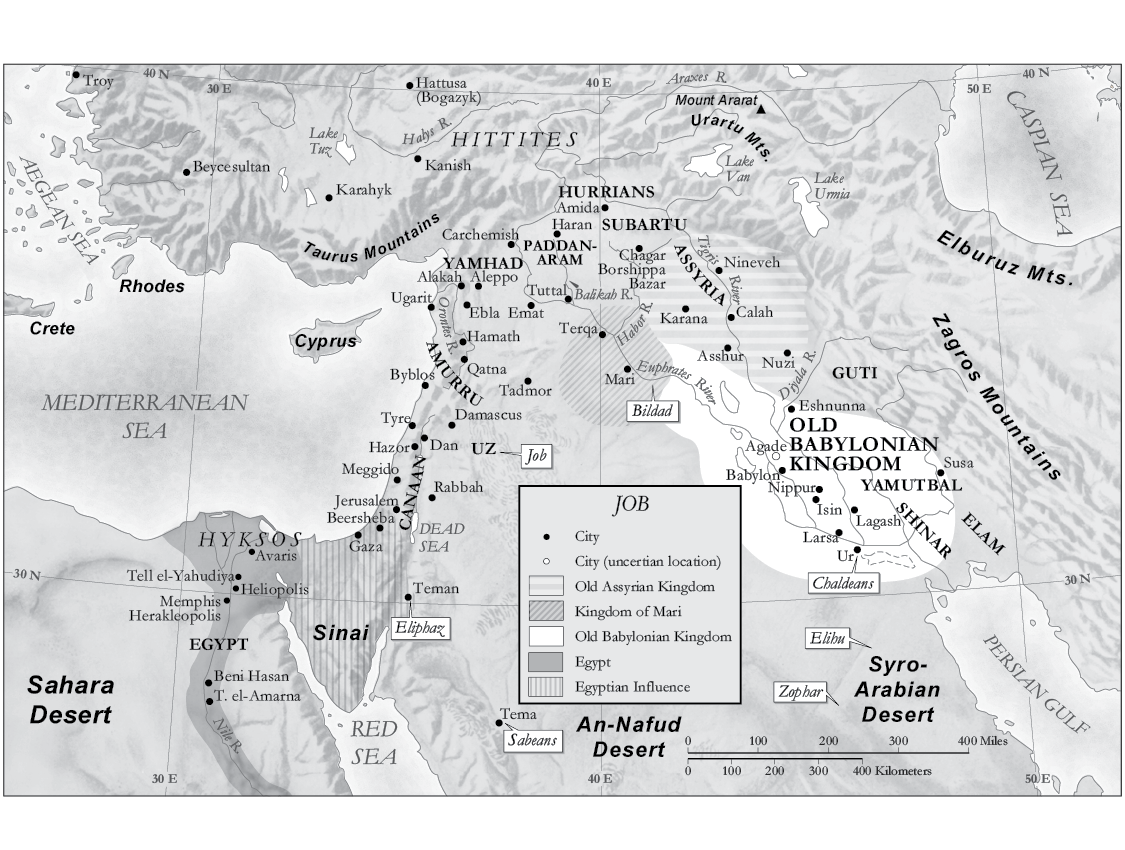
Outline of Job
- Prologue (chs. 1–2)
- Dialogue-Dispute (chs. 3–27)
- Interlude on Wisdom (ch. 28)
- Monologues (29:1;42:6)
- Epilogue (42:7-17)
Where Do We See Christ?
This ancient story has profound relevance for believers today. Just as Job faced the false accusations of his friends, the righteous today face the relentless accusations of Satan, the great accuser (Revelation 12:10). Satan is always eager to point out our sins, to dredge up our past failures, and to whisper lies into our hearts that we are too sinful, too broken, and too wicked for God to love or forgive us. He seeks to undermine our trust in God’s grace, to make us doubt the sufficiency of Christ’s sacrifice, and to lead us into despair.
But the truth remains unshakable: those who are in Christ stand faultless before God—not by their own merit, but because of Jesus’ faithfulness in offering forgiveness. “For by grace you have been saved through faith, and that not of yourselves; it is the gift of God” (Ephesians 2:8). Our righteousness is not our own; it is the righteousness of Christ that covers us, shielding us from the accusations of the enemy (2 Corinthians 5:21). Just as Job found peace in the knowledge of God’s justice and mercy, we too can find peace in knowing that our standing before God is secure. It is not because we are perfect, but because Christ’s perfect sacrifice has atoned for our sins (Hebrews 10:14).
Point of Application
How can we apply this to our lives today? & Discussion Questions
Pain inevitably afflicts each one of us. Suffering is unavoidable in this life. Will your relationship with God be enough when trials come? Will you trust Him through your suffering? Read Job 38–42. Spend time with the Almighty. Pray for a stronger faith in the powerful Creator described in those chapters. Pray for a right perspective of Him so that you might see your situation through His eyes.
Instead of asking where God is in the midst of your pain, the book of Job affirms God’s control and asks us, “Where are we in our pain? Are we trusting our Creator, even though we cannot understand our circumstances?”
Closing Prayer
Almighty Creator of the Heavens and Earth, we are but helpless creatures and forget Your ways are inscrutable sometimes but You are Good. You are the Source of Good. Help us to cling to you and to trust you when we are tested in our pain.
Current Prayer Requests:
Doc – renewed vigor to join us on Saturdays
Richard Brooks – faith and courage during the next stage of his journey in Christ
Andrew McKinney – employment provision
Bob & Gaynelle – mother’s hospitalization (from Mike Arras)
Julia (Arras) – health
Jim Allen, friend of Daryl, heart issue, VLAP operation
Jim Sachs – job situation, improvement, wisdom for interaction with leadership
Daryl’s employee Tara – ill (possible tumor) in Cambodia
Daryl’s Son Jonathan and Wife Lizz – spiritual renewal
Tom and Jeanice – Divine Healing and Peace in their spirit
Becky and Lee Davidson, health and healing
Jim & Melissa, father-in-law’s heart condition and spiritual health, marital closeness
Mike Arras’ daughter, mental and spiritual health
Mike Arras’ son, Trevor – employment
Mike Allen – sister Adele and brother
Joe & Deb – continued prayers for Deb’s Dad
Additional Content
FOR GREATER HISTORICAL UNDERSTANDING: JOB AND ANCIENT WISDOM LITERATURE
Several ancient Near Eastern texts deal with the problem of seemingly unjust human suffering. These include “The Tale of the Eloquent Peasant” (Egyptian, c. 2050 BC), the account of “Keret” (Ugaritic language, c. 1400 BC), and “The Sufferer and the Friend” (Babylonian, c. 1000 BC). In all three stories the main character experiences some tragedy or hardship and pleads for help while questioning the justice of the circumstances.2 The main difference between these passages and Job is that those stories affirm belief in many gods (polytheism). In contrast, Job and his friends believe in only Yahweh (monotheism). When Job suffers, he can only go to the one true God for answers. In this way, the ancient parallels to Job are like the ancient parallels to the Bible’s creation account.

Leave a comment